Filed under: Gettysburg, Understanding Battles | Tags: Battle of Brandy Station, Bud Hall, Craig Swain, Eric Wittenburg, Sam Elliot
Yesterday, I was able to walk parts of the Brandy Station battlefield with Clark “Bud” Hall, Eric Wittenburg, Craig Swain and 150 of my closest friends. The Loudon County Civil Roundtable arranged the tour.
I’ve said it before and I’ll say it again, there is no better way to understand a battle than to walk the ground. Sam Elliot, who played John Buford in “The Movie” (as we called it in the Gettysburg Discussion Group) understood this and knew walking the ground would help him get into character. When we stood on Buford’s Knoll with Bud Hall, he related the story of guiding Sam Elliot on the battlefield. Elliot asked where Buford stood during the battle and so, Bud pointed around them and said that Buford had been on the knoll. Sam wanted something more specific, so, Bud tells us, he picked a spot and Sam went and stood there. For a few minutes, they stood in silence, Sam examined the ground and getting into character as Buford. It was as though he was commanding the battle silently, watching his orders unfold. I need to re-watch Gettysburg to see Sam Elliot talking about the ground and the troops marching. I think he truly felt it, for Bud says he turned to him after standing on that spot and said, simply, “Hot damn.”
The folks from Civil War Trust were there, and, often during the day, we talked about their ongoing efforts for battlefield preservation.
Sadly, I had to head back to Washington early and missed being on Fleetwood Hill and an evening of conversation with my friends and fellow historians. It was a good day, but too short due to my prior commitments.
Filed under: American Revolutionary War, Marines | Tags: American Revolutionary War, Boston, Jesse Adair, John Pitcairn, Lexington, Royal Marines
We’ve mentioned a number of the British commanders and linked to some biographical information, but it may be useful to learn a bit more in-depth about the two Marine officers who played such significant roles in the Battle of Lexington.
Major John Pitcairn
Major Pitcairn was 52 years old at the time, so, no spring chicken. When Pitcairn had joined the Marines in 1746, they were still a part of the Army, though they did serve on Navy ships. He fought in the French and Indian Wars as a Captain, so he may have served between 8 and 17 years as a Lieutenant. Then he served at least 8 years as a Captain before his promotion to Major had come in 1771.
Unlike the British Army at the time, in which officers purchased their commissions, advancement in the Marines was purely by seniority. Since the Admiralty had determined that field grade commissions in the Marines had been largely honorary, no Marine officer was promoted to Colonel until 1771. This neatly coincides with Pitcairn’s promotion to Major, so his stalled advancement was greatly helped by that change.
When he arrived in Boston in 1774 to command the Marines, the situation was not exactly what we would imagine when we think of “Royal Marines”:
In Boston, he found that the marines he was to command were lacking adequate supplies, clothing and were an ill-disciplined lot. Drunkenness, fueled by the potent and cheap rum available in Boston, was so bad that Pitcairn took to living in the barracks with his men to keep them from drinking rum and wrote directly to the First Lord of the Admiralty describing the problem. He even blamed the rum for deaths in his regiment. Pitcairn enforced harsh discipline and marched his regiment hard and often on Boston Common. This toughening-up up proved invaluable to his marines on the long and bloody retreat from Concord.
— From Edward Witek‘s post on Pitcairn at Lexington
On the other hand, I might hear some arguments from those who have commanded Marines in garrison that, under poor leadership, that is exactly what a garrison can devolve to regardless of lineage.From the initial designation of Duke of York and Albany’s Maritime Regiment of Foot in 1664 until the disbanding of what had grown to 10 regiments of Marines in 1748, the size and organization of Marine units within the Army seems to have varied widely. While we always think of the elite Royal Marines today, they hadn’t been awarded that designation by King George III until 1802.
In 1755, the Marine Corps expanded to 50 permanent companies, each of which belonged to one of the Grand Divisions – Chatham, Portsmouth or Plymouth. Interestingly, the Marines companies in Boston were from all three Grand Divisions. My impression is that their nominal roots in a particular Grand Division had little affect on whether they were familiar with each other, as they would not often be formed into battalions anyway. Since that hadn’t occurred in the Americas since 1759 at Quebec, it is likely that few of the officers, NCOs and certainly none of the privates had ever “seen the elephant”.
Pitcairn would not survive the war, dying in the Battle of Bunker Hill.
Lieutenant Jesse Adair
Adair is characterized in some of the passages that I’ve read as a young, impetuously aggressive officer. One would imagine that in a Marine Lieutenant from an Irish family with a strong military heritage. However, Adair was not a young officer. He was somewhere between 35 and 44 years of age at the time, though he certainly was aggressive. He may also have served in the French and Indian Wars with Pitcairn. At the Battle of Bunker Hill, Adair would be noted , not only for his courage in surmounting the colonist’s defenses, but also as the “Eldest Lieutenant”. (That makes his promotion with the seniority system not indicative of any particular merit.)
There is also a story of Lieutenant Adair as not quite the sharpest officer during the 1776 evacuation of Boston as he was dispatched along Boston Neck to impede any pursuit.
Lieutenant Adair of the Marines, an acting engineer, was ordered to strew crow-feet in front of the lines to impeded the march of the enemy, as it was supposed they should attack our rear. Being an Irishman, he began scattering the crowfeet about from the gate towards the enemy, and, of course, had to walk over them on his return, which detained him so long that he was nearly taken prisoner.
Though it may simply have been an ethnic joke at the Irishman’s expense.
Adair did survive the war, rising to command of the 45th Company of Marines, “but was not the sort of officer who flourished in peace. In 1785, Captain Adair was ‘reduced’, and disappeared from the Marine List.” (Paul Revere’s Ride by David Hackett Fischer, p282.)
- Part I: The Battle of Lexington
- Part II: The British Marine Officers: Pitcairn and Adair
- Part III: The Battle of Concord
- Part IV: General Gage
Filed under: Books, Leadership, Marines, Officers | Tags: Douglas Southall Freeman, Duffel Blog, Iwo Jima, James Mattis
There’s no mistaking the respect of the Marines for many of their Generals and high in the pantheon must be General James N. Mattis. Back in 2004, “a colleague wrote to him asking about the ‘importance of reading and military history for officers,’ many of whom found themselves ‘too busy to read.'” Mattis responded in an email that has since gone viral. Mattis continues the grand tradition of well-read Marine officers who also excel in combat, following the example of none other than Chesty Puller, who carried a copy of Douglas Southall Freeman’s “Lee’s Lieutenants” with him in the Pacific. In his email, he dispenses with those who think there is nothing to learn for the modern warrior from books:
For all the “4th Generation of War” intellectuals running around today saying that the nature of war has fundamentally changed, the tactics are wholly new, etc, I must respectfully say … “Not really”: Alex the Great would not be in the least bit perplexed by the enemy that we face right now in Iraq, and our leaders going into this fight do their troops a disservice by not studying (studying, vice just reading) the men who have gone before us.
Filed under: Cemeteries, Medal of Honor, WWI | Tags: 369th Infantry Regiment, 93rd Infantry Division, Arlington Cemetery, Croix de Guerre, French Army, Harlem Hellfighters, Henry Lincoln Johnson, Herman A. Johnson, Medal of Honor, Tuskegee Airmen
Filed under: American Revolutionary War, Leadership, Marines, Resistance, Understanding Battles | Tags: American Revolutionary War, Benjamin Bernard, Concord, Francis Smith, Jesse Adair, John Hancock, John Parker, John Pitcairn, Johnathan Harrington, Lexington, Paul Revere, Prince Estabrook, Samuel Adams, Thomas Gage, WIlliam Dawes
On the night of 18 April 1775, the British occupying Boston set out to seize a weapon’s cache at Concord, Massachusetts. On my visit to Boston over the weekend, I was reminded of some of the ingredients of this disaster.
General Thomas Gage had been appointed military governor of Massachusetts in 1774, but his 3000 troops affected little outside of their garrison in Boston. As such, when he was ordered to seize the rebellious colonists weapons and arrest Samuel Adams and John Hancock, his troops had to set out from Boston to do so.
In order to retain the element of surprise, no one was told in advance of the expedition. It has been speculated that General Gage’s wife, who reportedly sympathized with the colonists, let word slip that the operation was going to take place. Regardless of whether that is true or not, the mustering of 700 soldiers at 9pm and preparations for marching would certainly have alerted the citizenry. So, the element of surprise was lost immediately and Paul Revere and William Dawes departed by separate routes to warn Adams and Hancock.
The British had sent out mounted patrols in advance to intercept just such couriers. Unfortunately, since such a patrol was so unusual, it served to alarm the locals and prompt rebel leaders to start rallying the militia anyway.
When choosing the composition of the force to march rapidly to seize the weapons and the leaders, Gage chose to draw each regiment’s light infantry company for speed and their grenadier company to serve as the shock troops. On the surface, this sounds like it might be a good strategy. The light infantry companies were made of soldiers used to moving fast, often serving as skirmishers and tended to be among the better trained and motivated troops in a regiment. The grenadier companies were also an elite company within a regiment, being composed of the larger soldiers, who by designation would have carried grenades and been chosen for their physical prowess. Each of the companies deployed with a lieutenant normally assigned to that company, however, the captains assigned were not necessarily familiar with the troops. Similarly, Marine Major John Pitcairn, who would lead the vanguard of the expedition, had never commanded the light infantry companies as a unit. Lieutenant Colonel Benjamin Bernard would have had the same circumstances with the grenadiers he commanded. Thus, the company-grade leadership was not familiar with the men, nor did they know their officers.
Gage also chose his most senior regimental commander, Lieutenant Colonel Francis Smith, to lead the expedition. Smith was regarded as cautious and methodical – a cool and courageous leader, but one with little imagination. Smith had not, of course, ever commanded the light infantry and grenadier companies as a separate unit, nor had the particular collection of company officers serving under him. It is entirely possible that in a garrison that included 13 regiments, he might not have even known all of his officers on the march. Perhaps not the best choice for a rapid expedition into a restive countryside.
I’ve been able to read the orders and reports of the British officers, which is critical to understanding what happened. The first thing that strikes me is the woeful inaccuracy in reporting the number of troops opposing the British forces, starting with a grand underestimation of their possible numbers and continuing with exaggeration of the number first encountered. For example, Major Pitcairn received reports from the vanguard of the light infantry companies advancing on Lexington that 500 militiamen were drawn up on the Green to oppose them. When Pitcairn arrived at the front of the column, he remembers some 200 militiamen filing off the Green when fighting erupted. There were approximately 80 men in the Lexington militia.
To return to the mustering of the troops in Boston, we head to Boston Common, where the troops headed when ordered at 9pm. By 10pm, the troops were assembled, but LTC Smith was late in arriving. While long-service professionals are well aware that any army is a “hurry-up-and-wait” operation, this could not have sat well with the men, who had likely been in formation early in the day, conducted their normal duties all day long and expected a normal night of garrison duties with a comfortable night’s sleep when surprised with these orders.
Unlike the extensive plans for loading and unloading that we know of for the amphibious operations in World War II, there was apparently no such plan for this operation. Similarly, they failed to obtain appropriate boats for the transport of the troops and they traveled on barges which were so tightly loaded that the men had to stand for the crossing. Not only that, but when arriving on the opposite shore, they had to debark in waist-deep water. Massachusetts in mid-April does not feature warm evenings or delightfully sunny days. So, troops who’d but awake since first light were cold, wet annoyed and still awake on the banks of the River Charles nearly 20 hours later at 2am.
An hour into the march, Smith dispatched Pitcairn with six of the light infantry companies to move more rapidly than the main column. An hour later, he sent back for reinforcements, realizing that his slow progress had cost him the element of surprise.
As they approached Lexington, Pitcairn was traveling at the rear of his advance party when he received the exaggerated report of 500 militiamen. He moved rapidly to the front to take charge of the situation.
When the British arrived on Lexington Green, Marine Lieutenant Jesse Adair was posted at the front of the column, likely due to Pitcairn’s familiarity with the Marine officer and trust in his judgement. Captain John Parker had his militia in formation off to the right side of the Green, so that they were not blocking the march of the regulars, but could make a show of force. Adair, seeing the militia drawn up off to his right, worried about the flanking position if the column were to continue forward on its march to Concord. The 80 militia men were in perfect position to rake the British column if they attempted simply to march past them to Concord. As such, Adair lead his troops forward, attempting to scare off the militia, his men reportedly shouted “Huzzah” to terrify the armed farmers, merchants and tradesmen.
Pitcairn arrived at the confusing situation, taking half of the companies off to the left along the road to Concord. Amongst great confusion and much shouting, a British officer demanded that the colonials disarm and disperse. The lack of familiarity and trust between officers and men played a role in the continuing confusion. These light infantry had just marched about fifteen miles from Boston, cold, wet and tired on the trail, annoyed at their officers and frustrated that the rabble in front of them did not simply disperse. On each side, officers had implored their men not to fire, but a gun fired and in the ensuing confusion, the angered light infantrymen opened fire on the slowly dispersing but not disarmed militia.
The horror that is battle took place in front of many civilians, including women and children who had gathered to watch the militia mustering. After all, the stand off, even if not involving violence, was sure to provide more excitement than anyone in Lexington had seen in most of their lives. A simple stalemate in which both sides had simply gone their own ways would assuredly have led to tales told in tavern and around town for decades. These civilians likely helped swell Pitcairn’s professional estimate of the number of militia, who may well have already begun to disperse by the time his attention was focused.
The resulting carnage was far worse than a tense stalemate and certainly has been told of for a few centuries now.
The officers struggled to get the men under control, calling for them to cease fire, but the damage had been done. A bayonet charge by the troops led to the death of Captain Parker’s cousin Jonas and six others were killed. Prince Estabrook, an African-American slave serving in the militia, was among those wounded, as was Johnathan Harrington, whose wound was fatal, raising the death toll to eight.
Colonel Smith rode forward to the sound of the guns, ordered a drummer to beat “Assembly” and restored order when the rest of the column arrived.
In Part II, we will meet a few officers, then examine the Battle at Concord in Part III, and continue by examining the commanding General, Thomas Gage in Part IV.
- Part I: The Battle of Lexington
- Part II: The British Marine Officers: Pitcairn and Adair
- Part III: The Battle of Concord
- Part IV: General Gage
Filed under: 101st, 506th, Band of Brothers, Gettysburg, Normandy, Operation Dragoon, Veterans | Tags: C.C. Sprinkle, Farnsworth, Mario Patruno
I really enjoyed the scene in Band of Brothers when a paratrooper rides up to Easy Company on a white horse. If memory serves, the soldier’s name is Farnsworth, linking in my mind with Brigadier General Elon J. Farnsworth who died at Gettysburg. Turns out that they may have been channeling Mario Patruno of F Company, 3/506th. Patruno visited the Military Museum of North Florida in February to pose with his own mounted likeness. There’s another, more extensive article on Patruno that was published in 2011 in the Mayport Mirror, which starts, “Army Pfc. Mario Patruno was 23, tough and fit. He’d fought in the ring as a youth boxer, and in the streets of Holyoke, Mass., with a brawling gang called the Bond Street Rovers.” Those paratroopers are an interesting bunch!
Of note, one of the other attendees was “C.C. Sprinkle, 91, who was the co-pilot of a B-26 Marauder during World War II and took part in Operation Dragoon, the invasion of South France in August 1944.” Hopefully, we’ll be able to get C.C. up to Washington for the Operation Dragoon Commemoration and Seminar in August.
Filed under: 517th, Films, Paratroopers, WWII | Tags: 517th PRCT, GI Film Festival
Last year, my wife, my mother-in-law and I all attended parts of the GI Film Festival here in DC. The 2013 version runs 6-12 May. Looking over the films, there are several I’ll be interested in seeing and they have not yet revealed what the “Red Carpet” films for Friday and Saturday night will be. I noticed in particular that “Saints & Soldiers: Airborne Creed”, which involves paratroopers from the 517th Parachute Regimental Combat Team is being shown on Saturday at noon at the AMC Shirlington. (Some of their web pages are contradictory, but I am sure will be updated closer to the date.)
Don’t forget, you can sign up as an intern or volunteer.
There are a number of WWII period films, so definitely expect to hear more from me as we get closer to the date.
You know I’m a sucker for a dog, plus have a special affinity for Marines. Should it be any surprise that the latest Marine mascot, Chesty XIV gets another post here? I hope not.
- Chesty XIV comes from Stephens City, Virginia. Josette Keeler of the Northern Virginia Daily wrote a marvelous article about him that has details about him, including that his ‘brindle mark’ on his right shoulder looks, as I thought, like he’s wearing camouflage already.
- There’s a great gallery of photos of Chesty at PawNation.
- PFC Chesty was awarded his Eagle, Globe and Anchor on Monday, having completed his recruit training and basic indoctrination. The Washington Times reports that ‘In the upcoming months, he’ll complete obedience training to underscore his military prowess and serve in a mascot-apprentice roll, trotting alongside his “predecessor and mentor” until the elder Chesty retires in late August.’
- It turns out that his predecessor, SGT Chesty XIII, got his promotion to Sergeant after a confrontation with the SecDef’s golden retriever, Bravo.
I will have to make sure to get down to the Marine barracks this summer to see if I can get a photo of Chesty.
Filed under: 36th, 3rd, 45th, 504th, Medics, Veterans | Tags: 141st Field Artillery Battalion, 34th Infanty Division, 39th Combat Engineers, 3rd Infantry Division, 401st Port Company, 45th Infantry Division, 9th Cavalry Regiment, Anzio
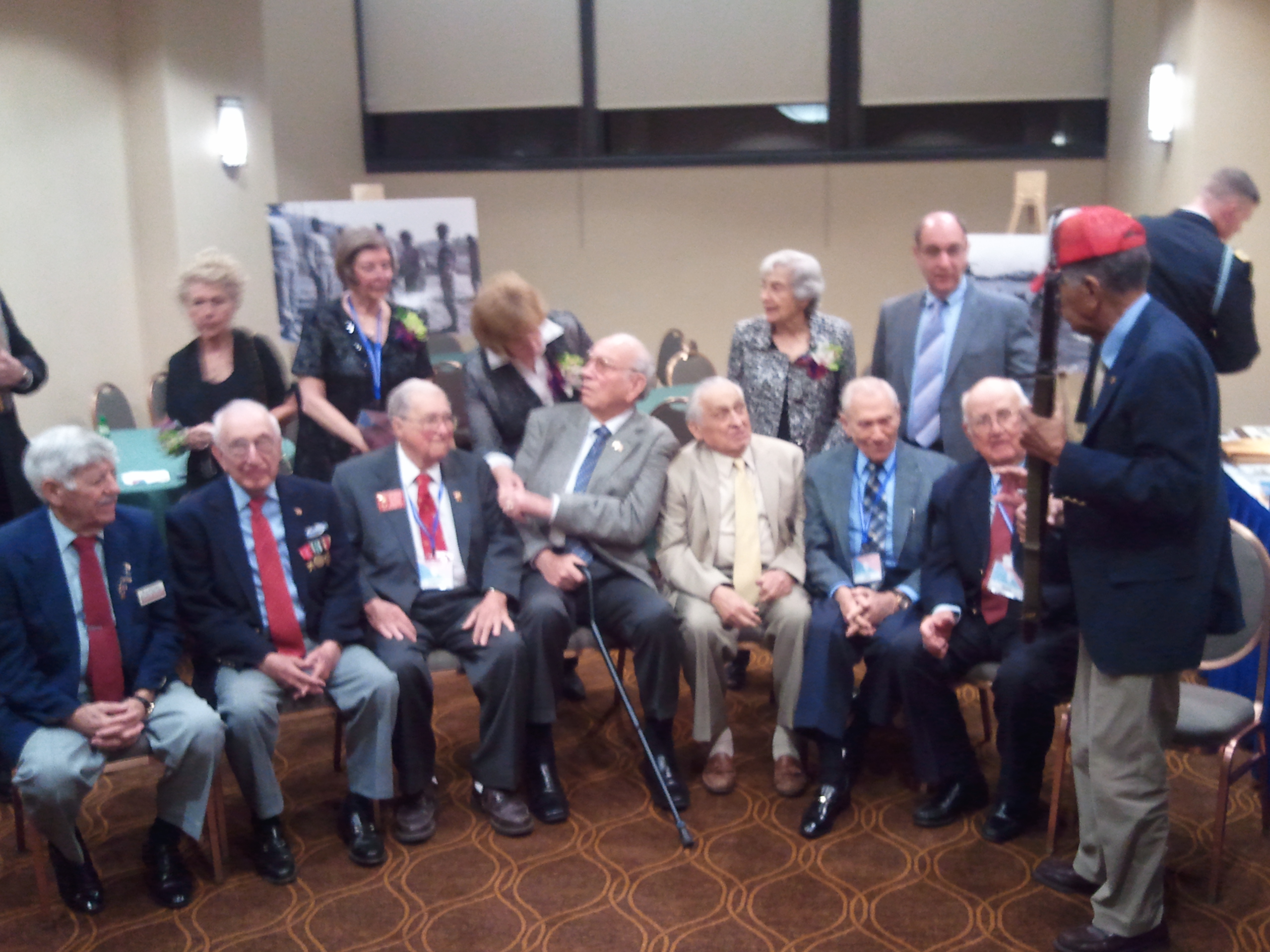 As I’d mentioned, I was able to attend the reunion of the Anzio Beachhead Veterans over the past few days, and it was a wonderful experience. Having helped with the Operation Dragoon and Colmar Pocket events, I was already familiar with the logistics of wreath-laying at the Tomb of the Unknown, so I was able to be more helpful than I’d expected.
One of the first things we did on arriving at the Amphitheatre was to visit Audie Murphy’s gravesite, which is right across the street. We were able to get the four veterans who would be in the wreath-laying grouped around Murphy’s headstone for photos. There were a dozen or so other visitors who happened along at the same time and our veterans got a wonderful experience of being “rock stars” with gratitude from everyone and requests for photos. It was a wonderfully heart-warming experience for me, seeing these men thanked and seeing the tourists get such a treat – to meet men who served with Murphy when visiting his gravesite.
I was able to bring along my own M1 Garand to the banquet and in this photo, you can see George holding what they all remembered as having been a far lighter weapon 69 years ago. George had enlisted in the Army and been assigned to the 9th Cavalry Regiment. Yes, George was a Buffalo Soldier, but when the Regiment reached North Africa, it wasn’t long before the Army decided to break up the unit. George ended up as a Sergeant in the 401st Port Company, unloading ships at the Anzio beachhead among many other places. He ended up making a career of the Army, retiring in 1967 as a Major, having served 24 years.
To George’s right is Billie Stone of the 39th Combat Engineers. Billie’s unit was, like George’s, not organically part of a specific larger unit, so they moved wherever the engineering work, or at times, the need for riflemen, was found.
Louis Kinofsky, C Company, 133rd Regiment, 34th Infantry Division, asked at the banquet when I handed him the M1 if he was going to get to take it home. Fortunately, he has one of his own there, so I get to keep mine. He had a lot of interesting stories, suggesting that when I read certain veteran memoirs, I take things with a very large grain of salt.
I sat with Frank and his wife at dinner and he related that despite this being the 34th reunion held by the Anzio veterans, it was the first he’d attended. Shortly after the war, He’d been to a few reunions of his unit, but since they’d always been held in the same location, after a few years, numbers dwindled as people hadn’t wanted to always visit the same place.
Ralph Joe Reid also served in the 34th Infantry Division, having arrived as a replacement before the Battle of Monte Cassino. When I sat talking to Joe on Thursday night, we talked about the aftermath of that battle. When his company was relieved by an Indian unit (I guessed Gurhkas, but am not sure), Joe, 13 other men and Captain Garfield were all that were left of his company. He also heaped praise on the 3rd Infantry Division, as the 34th replaced the 3rd and enjoyed their well-constructed foxholes in the Anzio perimeter. Joe said it was like living in the Sheraton after having only piles of rocks as protection at Cassino.
Current President of the organization, Ed Benezech, was a field artilleryman in the 141st Field Artillery Battalion, but when I had him pose with the M1 for photos in front of the organization, he went through an impromptu manual of arms. He’d drilled men with the rifle enough times that he felt completely comfortable with it.
John Boller, second from the left, is a former President of the group and it was through John’s notices in the Society of the 3rd Infantry Division newsletter, Watch on the Rhine, that I’d learned about the reunion. Without John, I’d have never known about it. His service with the 3rd ID during the war has continued in these decades since, and, as I said, seeing John explain to those tourists that he’d served with Murphy (though not known him personally) is a memory I’m sure they will treasure, as I know I will.
Among the issues discussed over the weekend was the continuing existence of the organization. With so few veterans still living, these organizations are turning to the children and grandchildren of the veterans. The organization’s modern website was designed by Bob Rickmeyer and we were joined by Barb Bossi and her brother, who have started work on a Anzio Families website that everyone will work to integrate into the existing setup. Hopefully, the energy of everyone can be harnessed for a grand reunion down in Orlando to celebrate the 70th anniversary next year.
At the far left of the photo is Louis Amato, who’d served as a medic in the 45th Infantry Division and then continued serving as a medic in POW camps after he’d been captured. Like most of these men, he’s quite a spark plug, the energy and humor bursting from him.
As I attend these reunions and meet these men, I am always struck by the obvious bonds they have for each other. While none of them knew each other during the war and some hadn’t met the others even before this event, they’d all been the same places and seen the same dangers. In the years since, those experienced shaped them, but when they have the chance to be around others who understand, it’s always good. Sitting with them and talking, knowing some of the context or being able to let them handle their weapons or uniforms from the war brings them to a comfort level where, as Joe said to me Thursday night, they can talk about things they’ve not spoken of for 69 years. Sometimes, their eyes light up and they speak with great animation about their comrades and the good times, or they pause, remembering those who never came home.
At a dinner party once, a woman asked me how I could devote so much study to something so terrible as war. For me, it’s the stories about people. While I enjoy studying the campaigns and knowing which units went where, the truly compelling thing is the people. War brings out extremes of the human condition – men doing terrible things and men doing completely selfless things.
“It is well that war is so terrible — lest we should grow too fond of it.”
Tonight, I sat down for dinner with a handful of veterans of the Anzio beachhead. I’ll be spending a few days with them and hearing, then passing on their stories. Meeting them is almost beyond words. Some of their stories have been bottled up for 69 years and it is a true honor to sit with them. Details to follow….
 We're not lost, Sergeant, We're in ... France