Filed under: Books, German Perspective, Marines, Normandy, Operation Dragoon, Paratroopers, Tours, Veterans | Tags: Cody Green, Denzel Washington, Heinrich Severloh, John Carter, Mark Dolfini, Omaha Beach, Paul Woodadge, Ted Gundy, Thanksgiving
Being the end of the year, I thought I’d look at some statistics and share them.
My top-ranking posts since I started this blog is dominated by one post, but the top 5 are all good posts:
Thanksgiving 1944 1,413
This got a huge number of hits due to being linked at Ace of Spades, thanks to our friends at Bring the Heat. On Thanksgiving of 1944, Eisenhower ordered that all soldiers have a turkey dinner. For airborne engineer John Carter, that provided a very humorous story that I was able to post the video of. I have some further videos of an interview with Carter and a couple of other stories. He’s quite a comedian.
While the Marine Corps is made up of strong men, they also have strong hearts. A couple of times recently, they’ve made young men with terminal illnesses honorary Marines. The story of Cody Green and his honor guard, SGT Mark Dolfini, can’t help but move one to tears.
Denzel Washington at the Fisher House 236
Denzel Washington is among my favorite actors. He has great range and conveys the emotions of his characters very well. Some of his roles have been as military men and he’s gotten attached to the Fisher House. Fisher House Foundation is best known for a network of comfort homes where military and veterans’ families can stay at no cost while a loved one is receiving treatment. When Washington visited the Fisher House at Brooke Army Medical Center in 2004, his generosity launched an urban legend.
Heinrich Severloh was a German machine gunner at Omaha Beach and the horrors he helped inflict that day stayed in his dreams until his death in 2006.
For about a decade, Paul Woodadge built up a battlefield tour business in Normandy, expanding from a one-man operation, hiring several others to lead tours. Battlebus was the best tour company in Normandy and even had tours in Bastogne. Unfortunately, running a complex business and dealing with French tax and employment laws meant that Paul stopped being able to lead tours himself. While I lamented the end of an era, it meant that Paul could go back to doing what he loved. He also had time to publish Angels of Mercy: Two Screaming Eagle Medics in Angoville-au-Plain on D-Day (Normandy Combat Chronicles) (Volume 1)
I exchanged emails with John Boller and the 70th Reunion for Anzio veterans will be held 1-4 June 2014 in Nashville. As soon as I have more details on the location, registration and schedule, I will post those. Mark your calendars now!
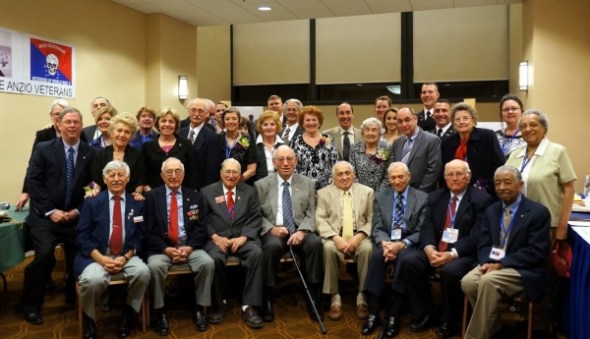
The 69th Reunion, held in Arlington, VA
Filed under: 3rd, Cemeteries, Navarre, Operation Dragoon, WWII | Tags: 15th Infantry Regiment, Anzio, North Africa, Roy Navarre, Russ Littel, Russ Navarre, St Francis Home for Boys
A few years ago, I’d joined the Society of the 3rd Infantry Division after meeting and helping CPT Monika Stoy and LTC Tim Stoy with the Operation Dragoon and Colmar Pocket reunions/commemorations/seminars. I’d developed an affinity for the 36th Infantry Division when I was assigned that as my research task, enhanced tremendously when my good friend, SGT Russ Littel deployed with the 136th MEB, of the 36th ID, to Afghanistan.
 I was utterly shocked then, a few days ago when my sister dropped me a note asking if I knew anything about the 15th Infantry Regiment. It turns out that our father’s uncle, Roy Joseph Navarre, served in Headquarters Company of the 15th Infantry Regiment during World War II. My father, Russ Navarre, never met his uncle because he was raised in the St Francis Home for Boys (which unfortunately burned in 2011 and was demolished). So, this comes as news to all of us. Fortunately, Tim is the historian of the 15th Infantry, so I fully expect to be able to learn far more about Uncle Roy.
For those who don’t know the story of the 15th, or it’s parent unit, the 3rd Infantry Division, in World War II, it fought in North Africa, in Sicily, at Anzio, landed in southern France (Operation Dragoon!), fought up the Rhone River valley, then through the Colmar Pocket and into Germany. I’m not sure when Roy Navarre joined the Regiment or if he remained in Europe to the end, but it will be interesting to discover and explore.
Now, I can join the 15th Infantry Regiment Association as well!
Filed under: Uncategorized
As time goes by, we lose more and more of our WWII veterans. My good high school buddy, Joe Meakin, who served in the Navy on carriers, passed along this blog entry about a Pearl Harbor survivor being granted a final wish. He wanted to visit the Navy in San Diego and he got more than just a visit. The sailors he met got more out of it than they expected as well.
Let’s wish fair winds and following seas, EM2 Bud Cloud.
Filed under: 36th, 3rd, 45th, Colmar Pocket, Veterans, WWII | Tags: 12th Armored Division, 28th Infantry Division, 36th Infantry Division, 75th Infantry Division, Audie Murphy, Bernard Bell, Charles P. Murray, Colmar Pocket, Eli Whiteley, Ellis Weicht, First French Army, Forrest Peden, Gus Kefort, Jose Valdez, Keith L. Ware, Russell Dunham, Veterans, WWII
69 years after the vicious fighting in eastern France, Outpost Europe of the Society of the Third Infantry Division and the Embassy of France will again host a Battle of the Colmar Pocket Commemoration and Seminar, on 5-8 December 2013 at the Sheraton National Hotel in Arlington Virginia. This event honors the divisions and veterans of the Battle of the Colmar Pocket, in which Audie Murphy, Charles P. Murray, Ellis Weicht, Bernard Bell, Keith L. Ware, Gus Kefort, Eli Whiteley, Russell Dunham, Forrest Peden, and Jose Valdez received the Medal of Honor. Also among the goals is to educate the public about this little remembered front known as the second Battle of the Bulge.
The Battle of the Colmar Pocket, Alsace, France – The “Other” Battle of the Bulge
December 1944 – February 1945
Outpost Europe, Society of the 3rd Infantry Division
The Embassy of France to the United States
When: 5-8 December 2013 (Thursday-Sunday)
5 December: 2 to 4 PM – Registration ($35); 5 to 8 PM – Reception and Seminar Session I
6 December: 8 AM to 5 pM – Seminar Session II and a historical visit (breaks for lunch & dinner on your own); 6 PM to 8 PM Seminar Session III & Documentary Film Presentation
7 December: 10:15 AM to 12 AM – ceremonies at Arlington National Cemetery: wreath laying at Tomb of the Unknowns, 3ID Monument, Audie Murphy gravesite; 12 AM to 4 PM Open time; 4 PM to 5 PM Cocktail Hour (no host); 6 PM Banquet ($40)
8 December: 9 AM to 11:30 AM – Seminar Session IV
Where: Sheraton Pentagon City Hotel, 900 South Orme Street, Arlington, VA 22204
Who: Veterans of the 3rd, 28th, 36th, and 75th Infantry Divisions; 12th Armored Division; XXIst US Corps; French Army Veterans; and their friends and families.
Why: To honor the veterans of the Colmar Pocket, to preserve history, to educate the public, and to pass on the torch of their proud legacy.
Room Reservations: Price – $95 per night, two days prior to event and one day after. Reservations: 1-888-627-8210
Reservation Group Name: Colmar Pocket, Cutoff date 26 November
Shuttle to/from airport provided by hotel, so no rental car required.
Point of Contact: Monika Stoy, President, Outpost Europe, Society of the 3rd Infantry Division, timmoni15@yahoo.com
Note that there is no limit on number of attendees, so even if you do not get an immediate confirmation, there WILL be space for you at the event. Make your travel plans and we will ensure everything works out.
REGISTRATION: Event registration – $35. Banquet – $40. (Free for Colmar Pocket Vets)
Sponsors: If you are interested in sponsoring an event at the conference (the banquet, opening reception on Thursday or the cocktail hour on Saturday, for example) or advertising in the event brochure, contact Monika Stoy, timmoni15@yahoo.com
Filed under: Marines, Veterans, WWII | Tags: Colmar Pocket, Iwo Jima, James Mattis, Operation Dragoon
Just wanted to get the word out that the 2014 reunion of the Iwo Jima Association of America will be held 13-16 February at the Sheraton Pentagon City, where we hold the Operation Dragoon and Colmar Pocket events. The strong turnout from active duty Marines always makes for a robust event and there were also many WWII veterans in attendance last year (fewer every year, though). I was able to get my photo with GEN James N. Mattis after his luncheon speech and truly enjoyed dancing to our favorite swing band, Radio King Orchestra at the banquet. It’s a marvelous event and I suggest that if nothing else, you spend $15 for the general registration to meet some of the veterans and enjoy the Saturday symposium (lunch is extra, but will include another excellent speaker and the banquet is extra, but includes not just a speaker, but plenty of dancing time as well!) The schedule can be found online and registration via Armed Forces Reunions is also available online. I’ll be present for the whole kit & kaboodle, since touring the Marine Corps Museum and visiting the Memorial with veterans of Iwo Jima is simply priceless.
Filed under: Marines, Navy Cross | Tags: 6 Seconds, Alex Apple, Beirut, Iraqi Policemen, Jonathan Yale, Jordan Haerter, Ramadi
Over on Bring the Heat, Bring the Stupid, UltimaRatioRegis wrote about the bombing of the Beirut barracks 30 years ago today. Fortunately, some lessons were learned and on the morning of 22 April 2008, LCPL Jordan Haerter (1/9) and CPL Jonathan Yale (2/8) had fully-loaded weapons. Recently, I finally saw the footage of the truck coming down the alley in Ramadi, thanks to a Facebook posting on In Jordan’s Honor. The footage is part of a CBS News report made when Haerter and Yale were awarded the Navy Cross.
As you watch the video, you see an Iraqi policemen at the gate, who lets in one person, then returns to his position to watch down the alley. Haerter and Yale are inside their sandbagged bunker, so you can’t really see them. As the truck bangs it’s way down the alley, you can see their efforts however, since their firing both generates little puffs and the vehicle is impacted by the rounds. The policeman, like any sane person who wants to save himself, turns and runs. Haerter and Yale do not.
That policeman survived.
Everyone in the barracks behind them survived.
My own favorite Marine, CPL Alex Apple, who was on post nearby, survived.
Haerter and Yale had the means to save the lives of their fellow Marines and the Iraqi policemen in those barracks, and they used them. Neither Haerter nor Yale survived.
In Beirut, 241 Marines perished and taught a lesson. In Ramadi, 2 Marines died demonstrating the value of learning that lesson. Let’s hope that their efforts and the lesson are not forgotten.
Also visit: Video remembrance of the Beirut Bombing produced by the Marine Corps.
Filed under: 36th, Operation Dragoon, Tours, Understanding Battles | Tags: 141st Infantry Regiment, 142nd Infantry Regiment, Charles DeGaulle, Frejus, Green Beach, Jean de Lattre de Tassigny, John E. Dahlquist, Lucien Truscott, Monuments, Red Beach, Saint Raphael, Sengalese
In our recent trip to southern France, I did manage to squeeze in some time down at Green Beach, where most of the 36th Infantry Division came ashore. Since our stay in France was focused on two weeks in Avignon, Green Beach was quite a long drive – over two hours from our lodgings. The short trip up to the Montelimar battle square was far shorter.
 We drove into the area Frejus, having used the A8 highway to come east from Avignon. Having spent a lot of time in rural France, enjoying the quaint and quiet villages, Frejus itself is something of a shock. We kept saying to each other how much it reminded us of going to Ocean City or the Outer Banks of North Carolina, since it was so Americanized. Well, maybe I shouldn’t say Americanized, just commercialized. The long plage in front of St. Raphael is a marvelous sandy beach and bikini-clad ladies parade past statues to the Senegalese troops, to General de Lattre de Tassigny and to Charles DeGaulle. It’s hard to argue with the people enjoying the beaches that were used in the liberation of France, since the soldiers fought exactly so that the beaches could be used this way. It’s still a little jarring to see a band playing for a crowd next to the statues of 5 soldiers who landed here.
Nonetheless, seeing Frejus Bay, you can understand how this soft sandy beach could have been a nightmare to assault. With the curve of the coastline and the rough terrain on anything that is not a sandy beach, you’d be landing troops into a kill zone. As they’d attack into Saint Raphael, they’d be exposing their backs to gun positions directly to their west. Since the remote-controlled explosive boats sent in to attempt early destruction of the obstacles were unsuccessful (radio interference likely helped scramble the signals and lead to some of these “drone” boats heading back at the fleet instead of into the beach), the Navy wisely decide to divert the planned landing of the 142nd Infantry Regiment from Red Beach and land them on Green Beach, secured hours earlier with the landings of the 2nd and 3rd battalions of the 141st Infantry Regiment.
 Because the 142nd diverted to Green Beach, where the 143rd Infantry Regiment had followed the landings of the 141st, all of the troops of the Division, other than the 1st Battalion of the 141st, ended up landing on Green Beach. So, it comes as no surprise that when it came time to commemorate the landing of the Division in France, that the monument went up on Green Beach. Of course, when we go to the parking area, I had to race to the beach first (and not just because there was a restroom down there, but that did spur me forward).
The shocker: it’s not a sandy beach. The entire landing area is covered with gallets, stones from the size of your hand to the size of your head. Needless to say, on the day that all the other beaches were swarmed with sun-worshippers, this beach had only a few dozen families. Melissa and I took off our shoes and gingerly approached the water, standing to allow the waters of the Mediterranean to wash over our feet. I raised my hands and shouted, “Lafayette, nous sommes ici!”
The map above does not at all convey what the terrain in the area is like. It’s rocky and hilly, imposing and difficult terrain, even with modern roads in place. Looking at the arrows on that map, you get no sense whatsover of how challenging the route along the coast eastward to Cannes really is. Some the materials I’ve read point out the challenge facing the 141st heading along that road. If you drive it, you can certainly understand how a few determined soldiers with machineguns and some explosives could halt a battalion-sized advance. The Germans, having been at war for half of a decade were experts at such actions. Thus, in this terrain, and later in the war in the Vosges Mountains, during the Battle of the Colmar Pocket, small groups in an army which some thought was already beaten, could inflict devastating casualties. This may help explain why, when General Truscott visited General Dahlquist’s headquarters during the battle of Montelimar, saw the terrain and the condition of the 36th Infantry Division troops and refrained from relieving Dahlquist on the spot.
As I find so often, when you walk the ground, you gain an understanding that is simply impossible to acquire from books and maps. I wish we’d had more time at Green Beach and been able to visit the drop zones, but mostly, I wish we’d been able to do so with a guide. I could relate some of what I’d read to the places, but it really takes significant study of the history and the terrain to be able to do more than scratch the surface.
Today is the 20th anniversary of The Battle of Mogadishu. Head over to Bring the Heat, Bring the Stupid to read XBrad’s interesting post on it.
Filed under: 36th, Books, Officers, Operation Dragoon, Understanding Battles | Tags: Fred Butler, John E. Dahlquist, Lucian Truscott, Montelimar
As I’ve said many times, there is no substitute for walking the ground. Looking at maps, reading unit/battle/campaign histories, or even using my new favorite tool, my tablet, never give you the same understanding as actually being on the ground where the fight took place.
We’re over in France and this time we’ve come to the south. This has given me an opportunity to walk the ground at Montelimar. Before we arrived, I’d contacted retired French Army Colonel Pierre Balliot to see if he could recommend a guide. He volunteered himself, driving 200+ kilometers to show us the ‘battle box’. The Colonel has written a marvelous book, of which I now possess a signed copy, entitled La Drome dans la Guerre: La bataille de Montelimar, which details the battle. So, my wife, our friend Tom and I got a half-day tour of the 20 km by 20 km ‘battle box’ in which Task Force Butler, the 36th Infantry Division and French partisans attempted to block the escape of 130,000 men of the German Army from southern France.
The battle of Montelimar had the same goal as the sealing of the Falaise Pocket in Normandy, trapping an entire Army Group. So, for me, the Battle of Montelimar is the most important action of the campaign.
Walking the ground here, you get a far better sense of why they chose the ground they did, what worked and what did not. The first thing to note is the height of the high ground. While the tablet and Google maps did point out the value of Hill 300, it gave no real sense of the true height or the slope. Somehow, I thought of 300 feet when I read about the Hill. It’s 300 meters or about 1000 feet. The slope is also extreme, making it difficult to dislodge any defenders. The Hill is so tall and long that it completely shields any troops coming up the Rhone valley through that choke point from observation or attack from the east. While there is plenty of high ground north of this, none overlooks such a tight passage as this. Thus, it comes as no surprise that there was tremendous fighting at La Coucourde, where the main road, Route Nationale 7, emerges from behind Hill 300 and where General Truscott had directed General Dahlquist to ‘put the cork in the bottle’, entrapping so many Germans.
Dahlquist and Butler faced many challenges here. The terrain that provided such an opportunity was itself a great challenge. The mountains restricted movement, inhibited communication, and provided endless opportunities for ambush. The narrow roads were difficult for armored vehicles and the slopes a great challenge as well. The vast distance from the landing beaches made resupply slow and the lack of sufficient transport compounded that.
The rivers helped, but not nearly as much as one would think when looking at the map. Walking the ground at the same time of the year, you see how low they are, how much vegetation would conceal movement and how challenging defending along those lines would be. Looking out from Dahlquist’s headquarters you see how broad a front he needed to defend.
Dahlquist himself may have been a part of the problem, never seeming to move fast enough for Truscott’s taste – Truscott flew to his headquarters twice during this campaign to hasten him along.
The few troops that reached the fight first shocked the Germans, but a few hundred men, even at strategic points, can only do so much to stop an Army Group.
 We're not lost, Sergeant, We're in ... France