Filed under: Gliders, Operation Dragoon, Paratroopers, Veterans | Tags: 1944, 551st, Dreams, Gliders, Jim Welsh, Operation Dragoon
At night, sometimes Jim Welsh dreams. One would think that when the dreams of a paratrooper turn to World War II, he would dream of parachuting, of his comrades or of narrow escapes they made during the war. Jim tells me that more often, he finds himself dreaming of the glider men.
At Fort Benning, when the paratroopers would run past the glider men, they’d mock them. After the paratroopers completed their five jumps, they would blouse their pants and show off their jump wings, while deriding the “leg” infantry men in the glider battalions. The paratroopers had each volunteered for hazardous duty and considered themselves among the elite troops in the Army. The glider men had been assigned to an infantry unit that had the additional duty of arriving in combat via glider. They didn’t choose their assignment, received no “jump pay” or other bonus and were not privileged to blouse their pants like paratroopers.
Jim Welsh remembers that morning in southern France in August of 1944 and he shudders. The dreams he has of the glider men are not pleasant, but based on what he saw them endure that morning. Surrounded by fellow veterans and historians, Jim starts his recollection with, “To me, it was an awakening….”
After the horror of the glider assaults in Normandy and the south of France, paratroopers had seen what the glider men went through and there was no more mocking. The glider troops started getting “jump pay” and a good measure of respect from their airborne brethren.
Filed under: 3rd, 509th, 517th, 551st, Operation Dragoon, Veterans | Tags: 551st, Arlington National Cemetery, Jim Welsh, John Carter, John Keller, Operation Dragoon, Richard Seitz, Roy Brumfield
Once again, the Operation Dragoon Commemoration & Seminar has come and gone. It was a marvelous event. There were about a dozen veterans in attendance (I heard 13, but I wasn’t counting heads), including the 4 who were awarded the French Legion of Honor at Arlington Cemetery (Dick Seitz, John Carter, Roy Brumfield and John Keller).
It was an entire weekend of “highlights” for me, so I am thrilled that I got so much of it filmed. Interestingly, both last year’s event and this year’s provided me with about 32GB of raw footage. I expect to post Jim Welsh’s account of being in the drop zone/landing zone with the 551st while the gliders were landing in the next few days. I already posted a picture of Robert Maxwell and I to Facebook, but have a short piece about him in progress as well.
Everyone in attendance was so interested and involved in sharing the history that you couldn’t help but feel closer to everyone by the end of the weekend. While it made parting sorrowful, it also provided an incentive for everyone to return in 2012. Keep August 2-5, 2012 open for the 68th Anniversary.
Filed under: 509th, 517th, 551st, Operation Dragoon, Paratroopers, Veterans | Tags: Arlington National Cemetery, Commemoration, Jim Welsh, John Carter, Legion of Honor, Operation Dragoon, Richard Seitz, Roy Brumfield, Salon-en-Provence, Veterans, Wreath-laying
I have some more details on the Operation Dragoon Commemoration and Seminar being held next weekend (4-7 August 2011). While I do not yet have the list of speakers, I can reveal the schedule. Most of the seminars will be held on the 4th and 5th, with the wreath-laying and banquet on the 6th.
The banquet has always been pretty special, as veterans who’ve had a chance to get reacquianted have an opportunity and enough comfort with the audience to provide very interesting recollections of the war, such as John Carter’s Thanksgiving 1944 story.
At the wreath-laying, the French Legion of Honor will be presented to Lieutenant General (ret.) Seitz (517th ABN), Mr. John Keller (3rd ID), Mr. John Carter (1st Allied Airborne Task Force), and Mr. Roy Brumfield (3rd ID). LTG Seitz was the battalion commander of 2/517 PIR during the war and I read an interesting story about the interview process for new soldiers joining 2/517 as they formed that I detailed in a post this past winter.

LTG Seitz at the 517th reunion in 2005
There is ample time on Friday and Saturday for some oral interviews and I’ll be trying to sit with both Mr. Carter and LTG Seitz. Of course, I haven’t had a chance to really talk to any 509th veterans at length yet and Jim Welsh of the 551st PIB would be a great interview as well. So, all kinds of opportunities. If you’re interested in conducting some interviews, you’re more than welcome to come.
4 August (Thursday) – Check-in to the Sheraton National Hotel, 900 South Orme St. Arlington, VA 22204
1500-1700 Registration
1700-1830 Dinner (no host)
1830-2030 Opening Remarks and initial historical seminar
5 August (Friday)
0830-1200 Historical Seminar Session 2
1200-1330 Lunch (no host)
1330-1700 Historical Seminar Session 3
1700-1830 Dinner (no host)
1830-2030 Operation Dragoon historical/documentary films
6 August (Saturday)
0900-1000 Commemorative Ceremony Memorial Amphitheater (Mil: ASU, Civ: Business Attire)
1015-1100 Wreath laying ceremonies – Tomb of the Unknowns, 3rd Infantry Division Monument, Audie Murphy gravesite
1130-1730 Lunch (no host) and free time
1730-2000 Banquet (Mil: Dress, Civ: Business Attire)
7 August (Sunday)
0900-1100 Concluding historical seminar/closing remarks
Special Honored Guests: Mr. Robert D. Maxwell, 3rd Infantry Division Medal of Honor Recipient in WWII and Operation Dragoon veteran and Mayor Michel Tonon, Mayor of Salon-de-Provence, France. More about T5 Maxwell and his Medal of Honor next week.
You can also email CPT Monika Stoy for further information.
As we roll into summer, it’s time to start planning on attending the Operation Dragoon Commemoration, to be held this year on 4-7 August at the Sheraton National Hotel in Arlington, Virginia. There will again be a ceremony at Arlington National Cemetery – at 0900 on Saturday, 6 August, 2011. Further details will be posted here, or you may contact Monika Stoy via email – monikastoy@yahoo.com
Filed under: 327th, 401st, Books, Operation Dragoon, Weekend Wanderings | Tags: Battle of the Bulge, Operation Dragoon
Ah, the joys of the NCAA tournament continue. My own university bowed out in the first round, but I always enjoy watching the underdogs have a shot. Richmond and VCU were both underdogs and both from nearby Richmond, Virginia, so I was hoping for them to both win and face each other for a chance at the Final Four. Fortunately, VCU won their game, so I’m watching them push Kansas right now.
- I checked for links on Dragoon the other day and found that Mitch Williamson over at War and Game had a blog entry on Operation Dragoon. There was also an entry on the 65th anniversary in Today’s History Lesson.
- I’ve always believed in the power of books. Glennor Shirley is the head librarian for Maryland prisons and there was a nice profile of her work in the Washington Post. I know where I want to send my next batch of books I clear from my personal library!
- I also heartily recommend a review of Battleground, part of The Best Picture Project. It follows members of I Company, 3/327th Glider Infantry Regiment (aka C/1/401).
Filed under: 517th, Operation Dragoon, Paratroopers, Veterans | Tags: 1944, Operation Dragoon, Thanksgiving, Veterans
As I sit here in my living room, on the couch, with the puppy snuggling next to my hip, the rain outside doesn’t affect us. Of course, for the men in the airborne in 1944, Thanksgiving wasn’t necessarily so comfortable. At the Operation Dragoon event this August, I met John Carter, who served in an Airborne Engineering Company and an Airborne Signals Company. John Carter was attached to the 517th Parachute Infantry Regiment and, for Thanksgiving 1944, situated along the Italian border, protecting the right flank of the 6th Army Group as it marched north.
On November 23, 1944, this Thanksgiving message from General Eisenhower was broadcast on the home front.
In this great war theater millions of America’s fighting men and their Allies are, by their courage, endurance and suffering, making daily headway against a fanatical enemy. They are surmounting unbelievable hardships and obstacles to insure to all of us the future right to live as free people. Mud, bitter cold, bullets and minefields cannot stop them if they are plentifully supplied and supported from the homeland. They need myriads of shells and tires and blankets and guns and planes – a thousand things to enable them to keep up the incessant pressure. These they must get from the money you lend to the government.
Another thing – they are entitled to the constant assurance of your understanding, of your resolution, and of your unflagging zeal in the cause for which they are offering their lives. To keep faith with them none of us can permit our minds and hearts to stray for a single second from the great task we have before us. In the current war bond drive, you once again have special opportunity to give these men the things they require and by so doing, reassure them and the whole world that the United States is a single, determined unit in working and fighting for complete victory.
There is just one way to gain the peace we want; each of us must work with ever increasing devotion and effectiveness up to the day the enemy capitulates.
We here – all of us – count upon you to over-subscribe the war loan and then to transform the money quickly into vital fighting equipment. It is needed, now.
Eisenhower also apparently decreed that every serviceman in the European Theater of Operations have turkey for Thanksgiving dinner. John Carter had volunteered for the Army. John Carter had volunteered for the Airborne. On Thanksgiving 1944, John volunteered to cook a Thanksgiving turkey on the front lines….
John’s wife, Fran, who is quite the pistol, says that John is allowed to cook at home despite the adventure of his 1944 Thanksgiving turkey. Fran built B-29s in Birmingham, Alabama, while John fought the Germans across France. After the war, they married and became professors at Samford University in Birmingham. In 1998, on the anniversary of Pearl Harbor, Fran founded the American Rosie the Riveter Association. There’s a great article about them in American Profile magazine.
On this Thanksgiving, I’d like to give thanks to John and Fran Carter, as well as the rest of the Greatest Generation, for their efforts. The spirit that they embody lives today in our service men and women, serving at home and abroad with little thanks or recognition. God bless John and Fran. God bless our troops. Happy Thanksgiving to all….
Filed under: Operation Dragoon | Tags: Lessons Learned, Operation Dragoon, Powerpoint
I attended the second annual Operation Dragoon conference over the last few days. It was, again, an amazing learning experience and a great opportunity to meet some of our World War II veterans. One evening, while I sat in the hotel bar, I got to pontificating a little bit, based on articles and books I’d read recently.
In the February issue of Naval Proceedings, there was an article by Dr Jim Lacey, entitled “Old Ideas Needed for a New War“. In the article, Lacey points out that “The Department of Homeland Security and even U.S. Special Operations Command are actually consulting science-fiction writers on a regular basis.” While this kind of ‘thinking outside the box’ can be commended, Lacey notes that it seems no one is asking military historians to look at the current situation to find examples in the past that might help today. This struck me as especially pertinent to our conference on Operation Dragoon, since it is so frequently forgotten when studying World War II.
So, as I sat there, trying not to sound to self-important, I mentioned that our planners really ought to be at the conference, soaking up “Lessons Learned”. A couple of chairs over, a senior officer was listening and asked, “Have you ever heard of a Lesson Not Learned?”
Sometimes, my junior-high, smart-aleck nature comes out, so I said that my life was full of them. If I’d learned the lessons the first time I made the mistake, I wouldn’t have made it twice.
While I did amuse myself with that, it got me wondering if anyone does look around for “Lessons Not Learned”. I wonder if that shows in any AAR’s? Because I assume that one of the points always covered is “Lessons Learned”, both as a way of showing what was learned and showing that you’re doing good analysis work (or at least engaging in appropriate Pentagon-speak).
This coming weekend, we’ll again be commemorating Operation Dragoon. Needless to say, I’m excited about the opportunity to learn more, but I’m also excited to be seeing some veterans I met last year. Jim Welsh, who fought with the 551st Parachute Infantry, is planning on flying up from Louisiana and we’ve already spoken about getting together for dinner. I hope that the two 509th veterans that I met last year (Katz and Devaney) are there again as well, since I picked up LT Hugh Hogan’s copy of Bail Out Over North Africa. (Hogan was an officer in the 509th and he signed his copy and wrote in the margins as well.)
Also, we’ve got our plans all sorted for our annual trip to Normandy. We’ll be there in October for a week (plus a few days in Burgundy to start, staying in a B&B run by a winemaker we met last year.) One of the best parts of that is that Paul Woodadge has let me know that he’d like me to tag along when he has a few spare hours during our visit. Quite a treat!
Filed under: 36th, 3rd, 509th, 517th, Operation Dragoon, Veterans | Tags: Audie Murphy, George Spears, John Devanie, John McManus, Kevin Hymel, Montelimar, Morton Katz, Operation Dragoon, Veterans
This past week I had Christmas in August. When I went to Normandy in June, I imagined that I would be surrounded by veterans and that I would be able to directly interact with them nearly constantly. I also assumed that I’d be able to find a way to volunteer some of my time while we were there to help some of these men out with mundane logistical or creature comforts during our visit. Sadly, it didn’t turn out like that at all. I did see a few veterans, but got little personal time with them (what interaction I did have was fantastic and emotionally moving for me) and found that the few people we asked about providing help already had it covered.
So, when word reached me that there was going to be an Operation Dragoon event in Arlington during the first few days of August, I immediately reached out to CPT Monika Stoy (USA-Ret) to see if I could help. It was the best idea I’d had in a long time.
The event was being put on by Outpost Europe of the Society of the 3rd Infantry Division, which meant that CPT Stoy and her husband, COL Tim Stoy, threw themselves and a few volunteers vigorously into it without knowing if anyone would help. I provided only a tiny bit of assistance, but got back far more than I could have imagined possible.
When I arrived late on Tuesday afternoon to see what I could do to help, Monika welcomed me and Tim started showing me the materials they’d gathered for display. While we were looking at some photos, COL Morton Katz wandered up and pointed out Doc Alden (Battalion Surgeon, 509 PIB) in the photo, at which point Tim explained that the reason he recognized COL Katz was because the fellow standing next to Doc Alden. I was very quietly stunned, as Doyle Yardley’s diaries (see my initial blog entry) remark frequently on Doc Alden’s amorous escapades. It got better when the gentleman standing next to COL Katz turned out to be COL Bill Yarborough’s son, Lee. My head was practically spinning as Lee took me to the front of the room to show off the poster made for his father, which showed the beret and Special Forces knife that he introduced. Then, Lee gave me a coin. It’s the unit coin for the LTG William P. Yarborough Chapter of the Special Forces Association. Quickly, I was invited to dinner and treated as a member of the group. Heady stuff for an amateur historian who never served.

One of our local Boy Scouts, COL Morton Katz, John Devanie and Mrs Katz next to the Audie Murphy memorial.
The next 24 hours were terrific. I showed up a few minutes late for my morning task of helping to transport the colors for the various units over to the amphitheatre at Arlington National Cemetery, but they’d managed to sort things out without me. Curse my lack of punctuality for that. It did, however, give me a chance to hover around the lobby while I awaited the return of our organizers. So, I spoke to Lee Yarborough again, as well as a Colonel and Command Sergeant Major from the 36th Infantry Division. As the veterans gathered, I wandered over and started to chat with COL Katz and John Devanie, who served in the 509th starting with the Avellino drop. I was able to chat with the both of them on and off all day, then got them both to autograph my copy of COL Yardley’s diaries, since it is the only book that I have on the 509th right now.
As a former Scoutmaster, I was overjoyed that a number of Boy Scouts were in attendance and, since I’m used to working with Scouts, I took multiple opportunities to provide encouragement to them, so that they would interact more with the veterans. I remember walking from the 3rd Division memorial to the Audie Murphy memorial and listening to one of the veterans asking his Scout “guide” how his work on his Eagle was going. The veteran explained that there were 21 merit badges required (there still are), but that there were no Eagle Projects back then. His own sons made Eagle and he knew how hard the project was for Scouts. I’m never sure whether Scouts understand how amazing some of the opportunities that being a Scout provides, but I know that having an adult express interest in their progress always makes a difference. That probably magnifies a lot when the interested adult is a hero, and these men are heroes. I may follow up with some of the units so that these guys can get a handle on exactly who the veterans were. Certainly, visiting Audie Murphy’s gravesite had to impress any of them who’ve studied military history, but I’m guessing that none of them knew much in advance about Operation Dragoon.

Don G. “George” Spears (F/2/517) and his wife
From the remove of 65 years, details often escape these men. On the other hand, some details never leave you. I asked George Spears during lunch about his unit and his recollections of his D-Day. I wondered if the drop was as screwed up like the one in Normandy, so I asked how long it was before he hooked up with other paratroopers. George said he hadn’t even gotten out of his harness and started assembling his rifle before an officer and a group of men came along the road. He said that you would recognize the officers from other units even if you didn’t know their names, so he joined up with them and spent the next four days as a runner at the Regimental Command Post. They’d lie around near the command post resting, waiting for an assignment, then, when called, head wherever they needed to go. We sat with a few soldiers from Fort Myer, including Specialist Nevarez who served in the 173rd Airborne Brigade in Italy and had one tour in Iraq. George was honest to a fault, relating when he simply couldn’t remember something. I truly enjoyed our lunch together, especially seeing how much his wife and he look after each other. As I lingered after lunch, I found George’s photo in his uniform posted along the walls, and, you know, he hasn’t changed all that much. 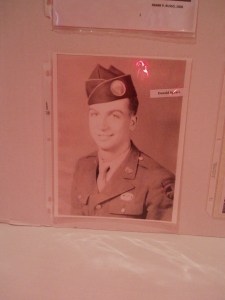 (Vimeo of George Spears)
I also got a chance to compliment COL Laura Richardson, who serves as the commander of the Fort Myer Military Community, having served as a Battalion Commander in Operation Iraqi Freedom. I pointed out that she wear jump wings, served in the 101st and was awarded the Bronze Star. I fumbled and said it was two Bronze Stars, though that does leave out a whole host of other awards and decorations. Of course, since Don was a paratrooper, it was probably unnecessary for me to point out the jump wings. I’d listened to the Colonel speak at the Inter-Service Club Council annual luncheon, held at the Army-Navy Country Club and had become an instant admirer.
During the Tuesday evening historical panel, a number of veterans went up to the front of the room and recounted some of their experiences very briefly. One veteran spoke about a German column they trapped outside Montelimar. The Germans were falling back, with horse-drawn carts, since they had few vehicles. He related that someone had destroyed the head of the convoy and they called in airstrikes that devastated the column. One of the veterans came up to ask about Montelimar later and said he didn’t remember any of that. Historian John McManus was on the panel and asked a few questions. McManus found out that the veteran had been in a Sergeant Connor’s squad (SGT Connor apparently had some incredible exploits on the day of the invasion, though all our veteran could remember was being guided around the minefields by a French partisan when they landed), so in all likelihood, the horror of the devastation of that convoy has blotted the incident from his memory. During our luncheon, an engineer spoke about the terrifying cleanup, which included not just German soldiers, but also many horses and French camp-followers who were retreating with the Germans.
Sometimes, when they spoke of their friends who never came home from southern France, or who didn’t survive the Battle of the Bulge, they paused. Chins would waver and their eyes would get misty. Not a day goes by that these men don’t remember Operation Dragoon, but in our focus on everything else, we sometimes forget. One gentleman recalled that when his Division was preparing to ship back to England later in the war, they were waiting alongside another unit that had fought in Normandy. One of those soldiers, seeing an unfamiliar Division patch shouted out, derisively, “Where were you guys on D-Day?” The 3rd Division troops, which had landed in North Africa, Sicily, Salerno, Anzio and southern France (5 D-Days!) and responded, “Which one?”
Though my own research will generally focus on Normandy, I will endeavor to remember the efforts of these and other men whose efforts have not been hailed so luminously.
 We're not lost, Sergeant, We're in ... France