Filed under: Books, Korea, Marines, Veterans | Tags: Anniversary, Korean War, Marines
Today is the 235th birthday of the United States Marine Corps. Happy Birthday, Devil Dogs!
Private Hector Cafferata, awarded the Medal of Honor for his actions on Fox Hill during the Korean War, has so much respect for the process of becoming a Marine and is so proud of being able to call himself a Marine, humbly says, “…even though I didn’t go to boot camp, I can call myself a Marine.”
Later this month, we reach the 60th anniversary of the Chosin Reservoir campaign. I just read Last Stand of Fox Company and read good articles about it in both American Rifleman (Arms of the Chosin Few) and Naval History (70 Miles of Cold, Hard Road and The Snowy Battle for Hill 1304). What those Marines accomplished in atrocious conditions, against insurmountable odds is simply beyond belief.
My sincere thanks and wishes that this may be the happiest of birthdays for the Corps, with special thanks to my own favorite Marines: Alex Apple, Joe Muccia, Frank Zamarippa, Fernando Castelli and Carl Kime.
Filed under: Gettysburg, Normandy, Tours | Tags: Gettysburg, Guides, Normandy, Tours
Recently, the folks who run Segway tours of Washington, D.C., complained to the Washington Post about the requirement for guides to be licensed in DC. I was surprised that there was any guide licensing, but I am a strong proponent of it. The rules strike me as pretty reasonable: pass a basic exam on DC history and pay a $ 200 fee. They see it as a conspiracy to keep the tour business in the hands of a few companies, rather than as a way to ensure that guides actually know what they’re talking about.
What are the arguments of those who oppose licensing of tour guides in DC?
- It’s a violation of free speech to prohibit them from referring to themselves as tour guides. This is like saying that it would be a violation of my right to free speech to tell people I’m a cardiologist. Anyone could claim expertise, but when you start charging for the use of that expertise, it’s no longer about speech, but about commerce.
- The tour guides from Segs in the City are experts anyway. Sadly, they probably aren’t. The guide interviewed for the story claimed she’d only been wrong once recently, in referring to the “founder of the Smithsonian” as Jonathan Smithson, when his first name is actually James, though she corrected herself shortly thereafter, and “it didn’t ruin anyone’s day” that she’d been wrong. Well, she did get his name right the second time, but she was wrong in identifying him as the founder. It was his money that started it, but it was 7 years after he died that it was founded. That she can’t remember being wrong isn’t proof of the extent of her knowledge. In fact, if you’re very confident when you’re wrong, people will think you’re right. If you’ve seen Slumdog Millionaire, you know that such confidence could earn you loads of money giving tours of the Taj Mahal even if you know nothing about it. Her complete lack of concern about being wrong galls me. It also wouldn’t ruin anyone’s day if she mixed up the names of the monuments, but it would still be wrong. Bill Main (the other owner of Segs in the City) stated that the Dred Scott decision “was on the books for a long time before it was changed, too,” though it was never actually overruled and was rendered moot with the passing of the 14th Amendment a mere 11 years after being written. Interestingly, I am told this same group made the same claim in Gettysburg, and failed the guide exam miserably.
- Some tour guides would only work one month, so the fee and background check is excessive. This is exactly the kind of people that are better off NOT charging money for tours. You have a bunch of college kids who generally haven’t lived in DC and don’t know the area, let alone have any depth of knowledge about it. Why should they be claiming to be experts and giving tours? The trouble for the unlicensed tour companies is that the fee and background check would either discourage young people from applying for the jobs (if they have to pay it) or reduce the company’s profits (if the company pays it). If someone only works as a tour guide for a month, what expectation is there that they know anything about the city? Heck, it sounds like the guides they hire are just doing it on a lark. Do we really want people who come to our nation’s capital expecting a serious, knowledgeable tour guide to be greeted by someone who only plans on doing it for a month before they go start their “real jobs”? Or do we want tours to be given by people who are professional and serious about it?
I think giving tours is a serious business and it’s one that’s incredibly easy to fake. All you have to do is be confident, talk fast and move quickly. Why is it easy?
- Tourist openly admit their ignorance. The tourist is in an incredibly vulnerable position. By seeking out a tour guide, one openly admits to lacking knowledge about the area. If the tour guide is very confident, but simply inventing facts, only a knowledgeable tourist would notice.
- In a busy enough location, reputation is irrelevant. If tourists are constantly arriving, you don’t have to worry if some of them think your tour was useless. They’ll go away and you’ll never see them again. Also, new customers will replace them immediately. Guide books or websites might help someone find a good guide or avoid a bad one, but when there’s another sucker born every minute, who cares?
So, I think licensing of guides is important and useful. What is the major benefit of guide licensing?
Some knowledge is guaranteed. Depending on how difficult you make the exam, you guaranteeing at least some level of knowledge in every guide. Gettysburg’s exam is intensely difficult, such that people devote years to studying for it, while the DC exam is apparently easy, with 91% of those taking the 100-question exam passing it. I’ve always been in favor of technical certifications because they ensure that the holder of the certificate at least knows the basics. If you have have to pay for your license, as well as pass an exam and a background check, you’re obviously going to be committed to it. It’s not something you do on a whim for a month. It makes the guiding business a career not a summer job.
Of course, what it really means is : The public can be certain they aren’t being ripped off.
I think having guide licensing would be very advantageous in Normandy. Tourists would be assured of at least a minimum quality for their guides and history wouldn’t get mangled by people who mean well but don’t know what they’re talking about.
Filed under: Gettysburg, Normandy | Tags: Angoville, Gettysburg, Normandy, Preservation
I was just posting a note to the Easy Company re-enactors about the Gettysburg casino and it morphed into a discussion of preservation and licensing of battlefield guides. As I neared the end of the post, I realized it was really something I ought to post here.
Having spent a number of years becoming familiar with American Civil War battlefield preservation and with the Gettysburg battlefield in particular, I’d been surprised when touring the Normandy battlefields for the first time that there are no French laws about battlefield preservation in Normandy. In theory, you could build whatever you want, wherever you want.

This gigantic silver-winged woman is supposed to represent peace
Having spent a number of years becoming familiar with American Civil War battlefield preservation and with the Gettysburg battlefield in particular, I’d been surprised when touring the Normandy battlefields for the first time that there are no French laws about battlefield preservation in Normandy. In theory, you could build whatever you want, wherever you want. One case in point is the 30-foot tall statue that China donated to Grandcamp-Maisy for the 60th anniversary of D-Day. It dominates the surrounding terrain (nothing else is over half it’s height) and especially the monument to the National Guardsmen who fought there. Of course, as we saw at Gettysburg, even having rules would likely not have prevented this well-intentioned monstrosity (though the locals may have rejected it had they seen it in advance). When talking with Paul Woodadge at the time, he felt that one of the good things about having no areas marked legally off-limits to development is that every piece of ground could be considered historically significant and worthy of protection. That is, if you mark only certain areas as protected, you lose the right to oppose development on areas not specifically protected. If I recall correctly, this very problem has occurred in Antietam, where someone put up several statues on their own land that may not fit in with typical battlefield interpretation. In Gettysburg, it’s lead to arguments over whether to allow a casino to be placed near the battlefield or even on non-protected battlefield land. Eric Wittenburg, who is an eminent civil war cavlary historian has noted that even preservation groups might end up supporting this nonsense.
Fortunately, Normandy is in the middle of nowhere from a French perspective (three hours from Paris, mon dieu!) with minimal industry and not a lot of job growth. Being so far from Paris makes it off the beaten track for any internationalists out there and without a lot of infrastructure that developers crave. The population of France is growing slowly – about half a million more people per year, I think – so there isn’t a high demand for new housing. Also, Utah and Omaha beaches are not particularly warm and delightful, even in summer (you see more French vacationers further east, near Honfleur and Le Havre). I’m guessing that if you’re a beach-lover, you end up with choices close to the beaches in Normandy if you want them. So, there’s not a lot of pressure to put new housing or resorts in Normandy. Melissa and I love it there and hope it never changes significantly.
Having seen what can happen when you do have demarcation lines in Gettysburg – that is, some people will think that anything outside the lines is fair game – I wonder if Paul is right. I would think that identifying the battlefield in Normandy might well be an impossible task because…. the whole of Normandy was the battlefield.
That said, I know that the southern end of the causeway into Carentan is far more densely built than it was in 1944. Similarly, Easy’s assault into Carentan, as shown in the series, approached the edge of town in 1944 (open fields on either side of the road) and now proceeds through an industrial and residential section of town. Carentan is likely the most changed part of the battlefield, since it has some light industry and has grown in population over the last 65 years.
If you wander back north, visiting Angoville-au-Plain, you’ll find that the commune has around 40 residents, just as it did in 1944. The town changed hands several times and I would venture that not a foot of ground couldn’t be labelled battlefield ground. How, then, would you regulate or legislate what these people could do with their land? All of Normandy suffered dearly for being a battlefield, with many civilians killed and wounded, others homeless and all scarred by what they endured. Would it be fair to rule that they and their descendants be again bombarded, this time by regulations? Or should we work to keep the history alive, the appreciation in the hearts and words of the French people and the love of that place alive in Americans? I’m not sure what the right plan is, but I know I want to be involved in ensuring Normandy can remain tranquil and beautiful, a monument to the people and to the soldiers who fought there.
Filed under: Band of Brothers, Bizory monument, Gettysburg, Normandy | Tags: Bizory, Easy Company, Gettysburg, Longstreet, Monument
This summer, I learned that one of the monuments in Belgium was desecrated by someone who scratched on more unit designations, since it was a monument to only one company. Of course, since Band of Brothers brought so much fame to E/506, it has also generated some resentment, since anything for them is more easily funded and more widely known.
It’s not hard to find people who either think that Easy Company was the best unit in the war, or those in the opposite camp, that think it despicable that the rest of the 101st Division or the rest of the Army gets so much less credit than these men. The individual who comitted the desecration falls into the latter camp and used to be the co-moderator of a forum on airborne history.
This individual felt compelled to modify the monument because he didn’t agree with it (he has publicly apologized, for what that’s worth). I’ve run across this attitude before – people who feel compelled to change the monumentation on a battlefield to better suit themselves. I would say that it’s to better explain the battlefield, or commemorate the deeds of the warriors, or to somehow enhance the value of the battlefield, but my impression of these people is that it’s rarely about anything but themselves.
In Gettysburg, the only Corps commander on either side who had no monument was General Longstreet. While it was odd and perhaps unfair, no monument had been made for the General while he was alive or in the early 20th century when the last veterans of the battle attended the last reunions. As such, to me, the lack of a monument to Longstreet was a story of the battlefield itself. Mentioning that he had no monument allowed one to explore why General Lee’s right hand wouldn’t have had a monument, leading to a discussion of reconstruction politics in the south, the relationship between Longstreet and Grant, as well as, perhaps, a discussion of the ‘Lost Cause’ movement. So, to me, the very fact that Longstreet had no monument was an integral part of the battlefield.

General Longstreet's monument in Gettysburg
However, a number of people worked very hard to get a monument built to General Longstreet. Unfortunately, they succeeded in putting up what some refer to as the ugliest monument on the battefield, taking away the interesting story about Longstreet not having a monument and replacing it with a story of how a bunch of hobbyists were able to band together and put up a monument to their hero. Longstreet had long been abused by the Lost Cause for a variety of invented reasons, but now, he has a monument on the greatest battlefield of the war. He must feel better! Except, he’s been dead a long time and the monument put him at ground level, on a diminuitive horse and his proportions look neither herioc, nor completely human. The artist also ensured that it would ‘violate’ the typical rules of military monumentation – often, the number of hooves off the ground on the horse is an indication of whether the rider was wounded or died in battle. (see note below on “folk wisdom”) At Gettysburg, all the equestrian monuments follow this guideline (there is no written rule) and it feels to me as though this was done because it was different and because it would stand out. So, we have a bunch of hobbyists working to make a name for themselves by putting up a monument and an artist who makes a silly-looking monument that defies convention, giving the impression he wants the monument to say something about the artist, more than something about Longstreet. So, for me, despite the fact it is nominally a monument to the man, all I can think about is the people who put it up.
In Belgium, Mark Patterson wished to make a statement by scratching unit numbers onto the Easy Company monument in Bizory. While I think we all would agree that every unit that fought there deserves a monument, it happens that because of Band of Brothers, getting money to put up an Easy Company monument is probably simpler than putting up a monument to F/501. That said, scratching the numbers on a monument and letting people know you‘ve done it, and done it more than once, is not about recognition for those other men who fought there. If you wish to honor the others who fought there, gather money, get the veterans out and put up a monument to them. Walking around pretending to be the champion of the unrecognized heroes by desecrating Easy Company’s monument is not about honoring the other units, but entirely about one’s own image. Fortunately, almost everyone I’ve seen write about this finds his actions reprehensible.
Sometimes, when listening or reading someone’s revisionist theories about a battle or a war, I also get the same impression. That it’s not about understanding, but rather about the speaker or author wanting you to notice that they have figured out something noone else has. They wish you to be dazzled by their brilliance, rather than being concerned with whether the theory actually matches with the evidence. Some of these theories are concocted by starting with a theory and then hunting down bits and pieces of evidence, sometimes out of context that support the theory. The worst cases require that you first ignore anything you know about tactics or strategy.
If you want to see the opposite of these actions, check out the work of the Stoy’s (CPT Monika Stoy and COL Tim Stoy). This August, they again took money out of their own pockets to fund the commemoration of Operation Dragoon. This year, the conference ran for 3 days, with several authors giving talks and about 20 veterans attending. The Stoy’s also travel around Europe, working to get monuments to these warriors installed or repaired in small towns throughout France and Germany. Often, their work brings remembrance of a debt owed to these men, and the towns celebrate them. It doesn’t tear someone down to build someone else up, or attempt to draw attention to themselves. It’s about the veterans and about what they did.
Note on “folk wisdom”: Check the comments for a discussion about the hooves on the Longstreet statue. Neither the Gettysburg Battlefield Monument Association nor any other organization has ever wrote any guidelines on the hooves in equestrian monuments. At Gettysburg, the hooves on the monuments do seem to represent the riders fate, but outside of Gettysburg, it is merely coincidental that sometimes this is the case. Check the Snopes article by Barbara Mikkelson for a good explanation of the failure of this “folk wisdom”. Thanks to Craig Swann for prompting the clarification.
Filed under: Operation Dragoon | Tags: Lessons Learned, Operation Dragoon, Powerpoint
I attended the second annual Operation Dragoon conference over the last few days. It was, again, an amazing learning experience and a great opportunity to meet some of our World War II veterans. One evening, while I sat in the hotel bar, I got to pontificating a little bit, based on articles and books I’d read recently.
In the February issue of Naval Proceedings, there was an article by Dr Jim Lacey, entitled “Old Ideas Needed for a New War“. In the article, Lacey points out that “The Department of Homeland Security and even U.S. Special Operations Command are actually consulting science-fiction writers on a regular basis.” While this kind of ‘thinking outside the box’ can be commended, Lacey notes that it seems no one is asking military historians to look at the current situation to find examples in the past that might help today. This struck me as especially pertinent to our conference on Operation Dragoon, since it is so frequently forgotten when studying World War II.
So, as I sat there, trying not to sound to self-important, I mentioned that our planners really ought to be at the conference, soaking up “Lessons Learned”. A couple of chairs over, a senior officer was listening and asked, “Have you ever heard of a Lesson Not Learned?”
Sometimes, my junior-high, smart-aleck nature comes out, so I said that my life was full of them. If I’d learned the lessons the first time I made the mistake, I wouldn’t have made it twice.
While I did amuse myself with that, it got me wondering if anyone does look around for “Lessons Not Learned”. I wonder if that shows in any AAR’s? Because I assume that one of the points always covered is “Lessons Learned”, both as a way of showing what was learned and showing that you’re doing good analysis work (or at least engaging in appropriate Pentagon-speak).
This coming weekend, we’ll again be commemorating Operation Dragoon. Needless to say, I’m excited about the opportunity to learn more, but I’m also excited to be seeing some veterans I met last year. Jim Welsh, who fought with the 551st Parachute Infantry, is planning on flying up from Louisiana and we’ve already spoken about getting together for dinner. I hope that the two 509th veterans that I met last year (Katz and Devaney) are there again as well, since I picked up LT Hugh Hogan’s copy of Bail Out Over North Africa. (Hogan was an officer in the 509th and he signed his copy and wrote in the margins as well.)
Also, we’ve got our plans all sorted for our annual trip to Normandy. We’ll be there in October for a week (plus a few days in Burgundy to start, staying in a B&B run by a winemaker we met last year.) One of the best parts of that is that Paul Woodadge has let me know that he’d like me to tag along when he has a few spare hours during our visit. Quite a treat!
Filed under: Edson Raff, Gettysburg, Normandy | Tags: 746th Tank Battalion, 82nd Airborne Division, Edson Raff, Fog of War, Gettysburg, Les Forges, Normandy
In my research on Edson Raff, I read about an incident that puzzled me, even in it’s basic form. Then, I started to find other versions of the same event and realized that not everyone saw the same thing in the same way. This is one of the joys of being a historian – having the opportunity to piece multiple accounts together to determine what is most likely to have actually happened.
On the 6th of June, Raff landed with his command on Utah Beach, raced forward in an attempt to reinforce the 82nd Airborne with a small armored force. They were able to roll out from the beach, with the roads already having been cleared (not necessarily “secured”), reach the crossroads at Les Forges and look north toward Ste-Mere-Eglise, where part of the 82nd Airborne was supposed to be gathering. I’d first picked this up in Clay Blair’s Ridgway’s Paratroopers, in which Blair relates that Raff’s force was held up…
The Germans who had fled Ste. Mere-Eglise and holed up in the woods to the south of town opened fire with 88s which had been zeroed in on the road. These accurate salvoes hit and destroyed an armored reconnaissance vehicle and three Sherman tanks and inflicted numerous casualties.
I’ve been to Les Forges twice now and it doesn’t seem like that deadly an area at first glance. Route Nationale 13 (N13), which was then a nice little road, is now a highway and it slopes gently down and back up as you approach Ste. Mere-Eglise from the south. It reminds me in that sense of Route 30 in Pennsylvania, as you drive east from Chambersburg to Gettysburg. In both cases, the approach is from a slight rise, with a gentle slope down and back up again. John Buford recognized the value of such ground from the defensive side, deploying his cavalry and cannon to slow the Confederate advance on the first day, west of Gettysburg. The men of the 795th Ost Battalion (Georgian) were posted on Hill 20, south of Ste. Mere-Eglise and for an anti-tank gunner, it is lovely ground.
Being curious about the incident, I searched for more information. I checked Blair’s sources and found two that looked promising, SLA Marshall’s Night Drop and Ralph Ingersoll’s Top Secret.
Marshall is the grand historian of the American airborne and I couldn’t believe that I’d never thought to buy his book. During World War II, Marshall was assigned to the European Theater and, it seems, was assigned the airborne aspect of the Normandy operation as a historian because everyone else was too busy. He was an early proponent of oral history, but his favored technique seems to have been interviewing entire companies at once. He relates in the epilogue to Night Drop that his interviews ended up being battalion-wide and, in the case of the La Fiere causeway fight, two battalions sitting for the interview at once. Marshall was Colonel Marshall at the time and I’ve read that junior officers, like Lieutenant Dick Winters, were generally a little intimidated by him. One can just imagine being interviewed by the Colonel in front of one’s own superior officers, with as much as two battalions of men listening in. While you might get a story that the senior officers could agree upon, it might not be what actually happened.
Though both men had been writers before the war, Ralph Ingersoll was a far different animal. While Marshall comes off as a solid “company man”, Ingersoll strikes me as a maverick. While Marshall worked as a war reporter for the Detroit News, Ingersoll published the leftist daily newspaper, PM, in New York City, which accepted no advertising whatsoever. Somehow, Ingersoll ended up a Major by the time of the Normandy invasion and get himself assigned as the Executive Officer of Raff’s force. After the war, Ingersoll wrote of his adventures in a series of books, with Top Secret including his time in Normandy.
Both men seem to sometimes embellish things for a good story and other times to simply get it wrong. Nonetheless, I mention them because of the drastic contrast in their reporting of the encounter of the Raff force with the Germans (well, Georgians in German uniforms) at Les Forges.
First, let’s look at Ingersoll’s account. Raff decides to send a scout car from Les Forges toward Hill 20….
Raff beckoned him up and said, “Go down and see what you can see.” The lieutenant got in the lead scout and it crept down over the brow of the hill. The tank engines were all silent and the rubber tires of the scout car whispered on the asphalt. It went down the far slope a little and halted to look around. Raff beckoned the sergeant of the nearest or our tank crews. “Go on down after him and cover him,” he said. The tankers climbed in and started their engine. The big hunk of steel lumbered up over the brow of the hill. Then it came close to the scout car and the latter began moving again and the two vehicles dropped down into the valley. In profile, the road made a very flat “U” through the valley. When the two vehicles reached the bottom of the “U”, there were two explosions in quick succession. Standing on the brow of the hill we could see the men piling out of the tank and out of the scout car and diving into the ditch on the right. Then everything was very still. And neither vehicle made a move or sound and nothing whatever happened.
What occurred next was a comedy turned tragic. The scout car and the tank which we had sent out ahead had been fire on all right, but neither had been hit and the crash we had heard happened when the scout car backed up suddenly and rammed its own tank. Both crews thought their vehicles had been struck by enemy fire and had piled out into the ditch. The first survivor was a terrified GI from the tank who had crawled all the way up the hill in the gutter. He reported that he was the sole survivor. Ten minutes later the lieutenant from the scout car came in, having circled through the fields. Sheepishly he explained what had really happened.
Ingersoll continues, describing further action that does involve tanks actually being hit, but the stark difference between Blair’s interpretation and Ingersoll’s first-hand account is shocking. So, of course, when I got my copy of Marshall’s book, that was the first thing I looked for. Marshall’s contemporary interpretation differs slightly.
Raff said to the lieutenant leading the reconnaissance platoon, “Take your scout car up the road and see what you can see.” Then he beckoned to the sergeant of his nearest tank and said, “Go on along and cover him.” The two vehicles advanced about 300 yards along the twisting highway. then Raff heard two explosions close together and saw the tank pile up on the scout car. A few minutes later the lieutenant returned afoot. He explained that one shell had hit his car dead on and, failing to explode, had driven it back into the tank with such violence that the track had been stripped away.
Since Marshall not only has a far different result of the German fire, but also uses slightly different quotes for Raff’s words to the lieutenant and the sergeant, I assumed he had other sources for his story. I was so excited because I thought I had found an account that SLA Marshall hadn’t included in his book. I remained that excited from June to August, continuing to search for more information and thinking I’d made a grand discovery. Then, I met Kevin Hymel, who has written an article about Raff in Normandy and I related the difference between the two accounts. He told me that he believed Marshall got it right, but I wasn’t convinced.
Then, I started to write this post and in the months it has taken me to write it… everything unravelled. Marshall quotes from Ingersoll’s book directly two pages later when describing the glider landings a few hours later. So, Marshall obviously read Ingersoll’s book and could have repeated his account. In Joe Balkoski’s Utah Beach, he doesn’t mention the incident, but he does quote from Ingersoll’s book as well. So, both of them read and disregarded Ingersoll’s account. The torture for me is that I don’t know if Marshall had access to other information (interviews with other men who were there or the after-action report from the tank company) because he doesn’t use footnotes, endnotes or even a bibliography. Balkoski does quote from the AAR of Company C, 746th Tank Battalion about the entire action, so I do know where I can look next. In all likelihood, I’ll never know exactly what happened, but it sure is interesting trying to figure it out….
Filed under: 36th, 3rd, 509th, 517th, Operation Dragoon, Veterans | Tags: Audie Murphy, George Spears, John Devanie, John McManus, Kevin Hymel, Montelimar, Morton Katz, Operation Dragoon, Veterans
This past week I had Christmas in August. When I went to Normandy in June, I imagined that I would be surrounded by veterans and that I would be able to directly interact with them nearly constantly. I also assumed that I’d be able to find a way to volunteer some of my time while we were there to help some of these men out with mundane logistical or creature comforts during our visit. Sadly, it didn’t turn out like that at all. I did see a few veterans, but got little personal time with them (what interaction I did have was fantastic and emotionally moving for me) and found that the few people we asked about providing help already had it covered.
So, when word reached me that there was going to be an Operation Dragoon event in Arlington during the first few days of August, I immediately reached out to CPT Monika Stoy (USA-Ret) to see if I could help. It was the best idea I’d had in a long time.
The event was being put on by Outpost Europe of the Society of the 3rd Infantry Division, which meant that CPT Stoy and her husband, COL Tim Stoy, threw themselves and a few volunteers vigorously into it without knowing if anyone would help. I provided only a tiny bit of assistance, but got back far more than I could have imagined possible.
When I arrived late on Tuesday afternoon to see what I could do to help, Monika welcomed me and Tim started showing me the materials they’d gathered for display. While we were looking at some photos, COL Morton Katz wandered up and pointed out Doc Alden (Battalion Surgeon, 509 PIB) in the photo, at which point Tim explained that the reason he recognized COL Katz was because the fellow standing next to Doc Alden. I was very quietly stunned, as Doyle Yardley’s diaries (see my initial blog entry) remark frequently on Doc Alden’s amorous escapades. It got better when the gentleman standing next to COL Katz turned out to be COL Bill Yarborough’s son, Lee. My head was practically spinning as Lee took me to the front of the room to show off the poster made for his father, which showed the beret and Special Forces knife that he introduced. Then, Lee gave me a coin. It’s the unit coin for the LTG William P. Yarborough Chapter of the Special Forces Association. Quickly, I was invited to dinner and treated as a member of the group. Heady stuff for an amateur historian who never served.

One of our local Boy Scouts, COL Morton Katz, John Devanie and Mrs Katz next to the Audie Murphy memorial.
The next 24 hours were terrific. I showed up a few minutes late for my morning task of helping to transport the colors for the various units over to the amphitheatre at Arlington National Cemetery, but they’d managed to sort things out without me. Curse my lack of punctuality for that. It did, however, give me a chance to hover around the lobby while I awaited the return of our organizers. So, I spoke to Lee Yarborough again, as well as a Colonel and Command Sergeant Major from the 36th Infantry Division. As the veterans gathered, I wandered over and started to chat with COL Katz and John Devanie, who served in the 509th starting with the Avellino drop. I was able to chat with the both of them on and off all day, then got them both to autograph my copy of COL Yardley’s diaries, since it is the only book that I have on the 509th right now.
As a former Scoutmaster, I was overjoyed that a number of Boy Scouts were in attendance and, since I’m used to working with Scouts, I took multiple opportunities to provide encouragement to them, so that they would interact more with the veterans. I remember walking from the 3rd Division memorial to the Audie Murphy memorial and listening to one of the veterans asking his Scout “guide” how his work on his Eagle was going. The veteran explained that there were 21 merit badges required (there still are), but that there were no Eagle Projects back then. His own sons made Eagle and he knew how hard the project was for Scouts. I’m never sure whether Scouts understand how amazing some of the opportunities that being a Scout provides, but I know that having an adult express interest in their progress always makes a difference. That probably magnifies a lot when the interested adult is a hero, and these men are heroes. I may follow up with some of the units so that these guys can get a handle on exactly who the veterans were. Certainly, visiting Audie Murphy’s gravesite had to impress any of them who’ve studied military history, but I’m guessing that none of them knew much in advance about Operation Dragoon.

Don G. “George” Spears (F/2/517) and his wife
From the remove of 65 years, details often escape these men. On the other hand, some details never leave you. I asked George Spears during lunch about his unit and his recollections of his D-Day. I wondered if the drop was as screwed up like the one in Normandy, so I asked how long it was before he hooked up with other paratroopers. George said he hadn’t even gotten out of his harness and started assembling his rifle before an officer and a group of men came along the road. He said that you would recognize the officers from other units even if you didn’t know their names, so he joined up with them and spent the next four days as a runner at the Regimental Command Post. They’d lie around near the command post resting, waiting for an assignment, then, when called, head wherever they needed to go. We sat with a few soldiers from Fort Myer, including Specialist Nevarez who served in the 173rd Airborne Brigade in Italy and had one tour in Iraq. George was honest to a fault, relating when he simply couldn’t remember something. I truly enjoyed our lunch together, especially seeing how much his wife and he look after each other. As I lingered after lunch, I found George’s photo in his uniform posted along the walls, and, you know, he hasn’t changed all that much. 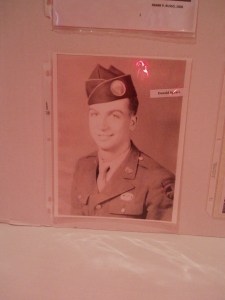 (Vimeo of George Spears)
I also got a chance to compliment COL Laura Richardson, who serves as the commander of the Fort Myer Military Community, having served as a Battalion Commander in Operation Iraqi Freedom. I pointed out that she wear jump wings, served in the 101st and was awarded the Bronze Star. I fumbled and said it was two Bronze Stars, though that does leave out a whole host of other awards and decorations. Of course, since Don was a paratrooper, it was probably unnecessary for me to point out the jump wings. I’d listened to the Colonel speak at the Inter-Service Club Council annual luncheon, held at the Army-Navy Country Club and had become an instant admirer.
During the Tuesday evening historical panel, a number of veterans went up to the front of the room and recounted some of their experiences very briefly. One veteran spoke about a German column they trapped outside Montelimar. The Germans were falling back, with horse-drawn carts, since they had few vehicles. He related that someone had destroyed the head of the convoy and they called in airstrikes that devastated the column. One of the veterans came up to ask about Montelimar later and said he didn’t remember any of that. Historian John McManus was on the panel and asked a few questions. McManus found out that the veteran had been in a Sergeant Connor’s squad (SGT Connor apparently had some incredible exploits on the day of the invasion, though all our veteran could remember was being guided around the minefields by a French partisan when they landed), so in all likelihood, the horror of the devastation of that convoy has blotted the incident from his memory. During our luncheon, an engineer spoke about the terrifying cleanup, which included not just German soldiers, but also many horses and French camp-followers who were retreating with the Germans.
Sometimes, when they spoke of their friends who never came home from southern France, or who didn’t survive the Battle of the Bulge, they paused. Chins would waver and their eyes would get misty. Not a day goes by that these men don’t remember Operation Dragoon, but in our focus on everything else, we sometimes forget. One gentleman recalled that when his Division was preparing to ship back to England later in the war, they were waiting alongside another unit that had fought in Normandy. One of those soldiers, seeing an unfamiliar Division patch shouted out, derisively, “Where were you guys on D-Day?” The 3rd Division troops, which had landed in North Africa, Sicily, Salerno, Anzio and southern France (5 D-Days!) and responded, “Which one?”
Though my own research will generally focus on Normandy, I will endeavor to remember the efforts of these and other men whose efforts have not been hailed so luminously.
Filed under: Band of Brothers, Leadership | Tags: Band of Brothers, Boy Scouts, Dick Winters, Leadership, Normandy
The other day, I was watching the “Day of Days” episode of Band of Brothers. I was struck yet again how good a job they do of demonstrating leadership.
In my years as a Scoutmaster, I was always looking for ways to make the lessons I’d learned on leadership strike home with the Scouts. Despite the fact that I am a voracious reader, I have never been able to read through any book on leadership other than the ones published by the Boy Scouts. Those spend a lot of time on the organizational roles and not so much time on how to lead. So, though I put copies of those books into Scouts’ hands when they take their Junior Leadership Training classes, I know they won’t learn a lot about how to lead from them. When I teach the classes, the Scouts have trouble absorbing best practices in leadership when it’s theoretical as well as when “role-playing” a leadership situation.
So, when Band of Brothers came out and I watched Lieutenant Dike fail in the attack on Foy, I knew there were some lessons there about leadership. So, I began using that as a visual tool for them to see good and bad leadership techniques. Watching Winters prepare Dike you see a variety of techniques from Winters to try to ensure Dike’s success, from expressing confidence to ensuring he understands and including physical reinforcement as he pats him on the back. Dike flops in a colossal manner and we see Winters torn about what to do. The Scouts are certain to experience nearly every angle of that sequence of events during their career in Scouting (except for the part about getting shot at!) Spiers demonstrates marvelous calm leadership and demonstrates personal commitment to the task. Watching all of that and discussing it turned on far more lightbulbs than I’d ever seen without that video sequence as tool.
I always encourage the Scouts at the end of that video session to start paying attention to the leaders in the war movies they watch. Which of them are effective? What techniques do they use? Will those work for them? Boys may watch war movies twenty times, memorizing lines and being able to tell you who did what at every step of the way, but without this higher focus on leadership, it’s just entertainment to them.
So, the other day, watching Lieutenant Winters and Private Hall, moments after they’ve landed, Band of Brothers instantly demonstrates why Winters really is a leader. They aren’t simply going to tell us the men respected and followed him. They are going to demonstrate Why they do. Hall is very jittery in this scene, worried that he’s lost his radio and that his Lieutenant is going to yell at him. Winters assures him that he’s a rifleman first (guess the Marines have the right idea!), but Hall remains unsettled by the fact that they’re lost. Winters then uses a time-tested military leadership technique – if someone is busy thinking themselves into worry, give them something to do! He also does it in a decidedly friendly way. He asks Hall to watch out for landmarks and, as he goes through the list of potential landmarks, he even injects humor, asking him to look for familiar trees. Right there, he’s won Hall over and when he sticks around for Brecourt Manor, it makes complete sense to us.
I drew the name for this blog from that scene. While in Normandy, our tour guide, Dale Booth told us that the confusion about John D. Hall or John D. Halls misses out on the fact that the soldier was actually a Sargeant, not a private, so my blog changes Winters’ line from “We’re not lost, Private. We’re in Normandy.”
Last year, my lovely wife asked me if I’d be interested in returning to Normandy for the 65th anniversary of D-Day. Of course, I nearly jumped out of my chair. She fell in love with Normandy on our honeymoon and wanted to go back. We are likely to go back several times, I’m sure. We even discussed the idea of moving there, though that is a rather slim possibility for now.
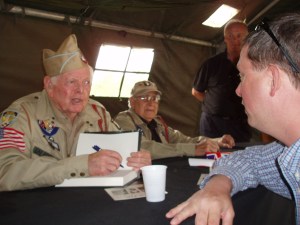
Bill Galbraith and Manny Barrios, with Roger Day in the background
So, we went to Normandy, stayed in a self-catering Gite, toured with Battlebus and visited many sites. The highlight of the trip for me was meeting four men: Roger Day, Ian Gardner, Manny Barrios and Bill Galbraith. Manny and Bill are veterans of I Company, 3rd Battalion, 506th Parachute Infantry Regiment. Roger and Ian wrote a book about the 506th, Tonight We Die As Men, and the four of them were signing it at the Dead Man’s Corner Museum. I’d heard about it from Paul Woodadge, who runs the Battlebus battlefield tour company, since he would be spending most of June 6th there. Both Ian and Roger were friendly, engaging and seemed honestly interested in my own little research project on Edson Raff.
When Bill was signing my book, I told him about Melissa’s father having served two tours in Viet Nam with the Signal Corps and I let Bill know what an honor it was to meet him. Melissa says that both Bill and I got a little misty over it. As I was talking to Roger, someone thanked Manny prodigiously and Manny said, “I don’t know why you’re thanking me. These fellas wrote the book.” To have given so much, but to expect so little is one of the things that distinguishes these heroes. There’s no pounding of their chests and proclamations that they’re “the greatest”. I’ve often heard veterans say that the heroes are the ones who didn’t come home. The humility and clarity of thought is amazing. Manny, we can’t thank them, so, please, let us thank you….
I got to talking to Roger in more depth about my research and he recommended Charlie Turnbow’s book (and another on the 509th that is out of print and currently selling for about $300). He perked up when he’d heard me talking to Ian about Edson Raff, so when I got down to that end of the line, he was percolating with information and ideas. It was such a pleasure to have someone know who I was talking about and where to look for more information. I’ve now received Charlie’s book from his wife, Beverly, and have started to read it. In a way, studying these men is a way of joining a community. There are other souls out there who are interested in the same things I am, and are eager to share their knowledge. They seem, as I know I do, overjoyed when they find another who shares their compulsion. Some of the joy of life is in sharing, be it sharing bread, sharing wine, sharing labor or sharing knowledge.
On August 4th and 5th, I’ll be attending events to honor the veterans of Operation Dragoon, to be held at the Sheraton Arlington. More opportunities to be with veterans and amongst the members of this community of historians.

