Filed under: Books, Marines, Weekend Wanderings, WWII | Tags: Bagram, Bears, Fallujah, Iraq, Marines, OSS
I haven’t posted a set of Wanderings of late, but have been accumulating some interesting links. Hopefully, you didn’t over-eat on Thanksgiving or, if you are not a celebrant, on a lovely fall weekend.
- Patrick O’Donnell, who wrote We Were One: Shoulder to Shoulder with the Marines Who Took Fallujah
based on his time embedded with a platoon of Marines in Iraq, followed up with his Marines in an article for the National Review. As with all of his writing, this is particularly moving.
- We’ve talked about the Poles fighting in World War II, but I never realized they had an unfair advantage – they had a bear on their side! Hat tip to theglyptodon for pointing this one out.
- Over at One Marine’s View, there’s a nice photo of the Occupy Bagram folks….
- On Forbes, Chandlee Bryan dispensed some good advice on cover letters for job seekers when she wrote about Steve Adams, who wrote The Perfect Cover Letter, proposing that the OSS drop him into the Italian Alps during World War II.
Filed under: Henderson, Paratroopers, Veterans | Tags: Agent Orange, Bll Messner, Rangers, Route 1, Russ Littel, Saumur, Signal Corps, Viet Nam
I don’t know if it’s fair to say that I miss someone I’ve never met, but I do feel that I do. My father-in-law, Lieutenant Colonel Richard Henry Henderson, passed away before I ever met my wife and though I know he was not the easiest man to get along with, I suspect that Dick and I would have been friends.
Born in 1935 down in Uvalde, Texas, Dick grew up outdoors, competing with and conspiring with his brother, much as my own brothers and I had. He must have had the same wa nderlust that drove me to find a way out of Michigan, but Dick’s way out was the Army. Commissioned in 1957, he “found a home in the Army”. As a young officer, he met his bride, Mary Lou Cammisa, and took her away from New York on an adventure around the country and the world. While he was stationed in Germany, they drove around Europe, exploring. The stories of the places they stayed and the mis-adventures pepper our conversations with my mother-in-law. Every time my wife and I turn in a rental car in Europe, I imagine Dick and Mary Lou sneaking away and breaking into a run as they leave behind the rental car in which a case of red wine had burst in the back seat. I can even, given the photos and descriptions from my wife, imagine Dick’s quiet, amused little snicker.
The Signal Corps was good to Dick, until it wasn’t. The good part was the training in technology and the advancement in both rank and leadership that occurred over the years. The bad part was over in Viet Nam. Signal Corps doesn’t sound so bad – you’re in the rear areas, and in some cases, he dealt with data processing. How dangerous can that be?
When Melissa and I went to France the first time, we visited the Loire Valley. I was able to connect with a retired US Army Signal Corps soldier – Bill Messner – who had married a French woman he’d met while serving at Signal Station Saumur in the 1950s. Bill had also served in Viet Nam and when we told him that Dick had cancer, Bill told us that a lot of Signal Corps men he’d served with in Viet Nam were dying of that as well. The bad thing about serving two tours in Viet Nam in the Signal Corps was that you had to drive up and down Route 1 a lot, checking and repairing the wires and equipment. So all those Signal Corps men got plenty of their share of Agent Orange.
Dick loved his girls, but Melissa never realized how much she’d miss him until the day of his funeral. He’d been a tough man, inspiring Melissa to write about growing up in his house as “Living with the Gestapo”. Of course, he was just trying to instill discipline and raise his daughter right. He didn’t make it easy for her to be close to him, but she tells me that despite the many times they’d butted heads even into her adult years, she wept uncontrollably at his funeral.
When we hold the Operation Dragoon and Colmar Pocket seminars, they always conduct a ceremony for the missing in action and prisoners of war, both at Arlington National Cemetery and again at the banquet. In this ceremony, a vacant chair and a place setting are laid out for the missing. I always think of the haunting lyrics of the Civil War era song, The Vacant Chair, “We shall meet and we shall miss him. There will be one vacant chair.”
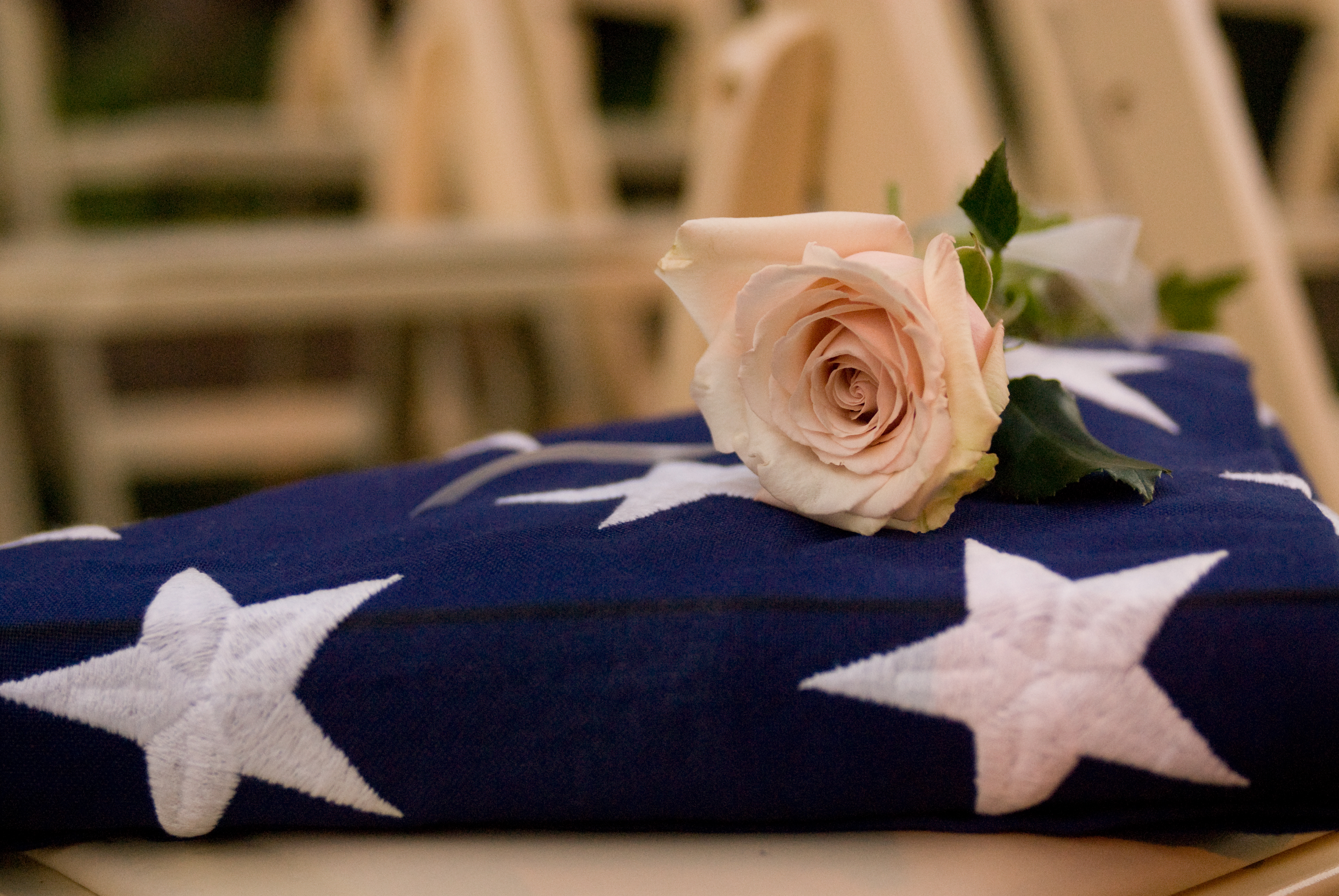 At our wedding, Melissa and I wanted to include her father, so our good friend, Russ, who is a Sergeant in the National Guard (and will be deploying overseas next year) was able to get a Bronze Star with an Oak Leaf Cluster for Melissa to carry on her bouquet to signify his presence walking her down the aisle. When our brother-in-law Steve Murphy escorted Mary Lou down the aisle, he carried Dick’s flag from his funeral in Arlington. As the flag passed Russ, wearing his immaculate dress uniform, he rose to his feet and delivered a crisp salute. Steve placed Dick’s flag on a vacant chair next to Mary Lou, so that his presence would be known to all.
This year at Thanksgiving, and every year at family events, my mind may well drift to the man whom I know would have been my friend. I will thank him for giving me his daughter and I will miss him.
Filed under: Bizory monument, Gettysburg | Tags: Monuments, Royal British Legion, Vandalism
The Royal British Legion had put up a bronze statue of a soldier in memory of all those from Tidworth who had fought and died in World War II. Unfortunately, with metal prices soaring, two men spent 40 minutes removing the statue one night, putting it in their car, likely to sell off as scrap metal.
I’ve written about Mark Patterson’s vandalism of the Bizory monument before. There is some good news there: when I asked another visitor to check for the vandalism, they couldn’t find it, so it may either have been repaired or been worn down to unnoticeable levels after 18 months. Mark’s was at least trying to make a point with what he had done. This act makes that seem miniscule, but the problem is that when even those dedicated to preserving the memory of WWII feel free to disrespect the monuments, how can we expect the average person to hold them sacred?
I worry for Gettysburg, where there are so many monuments and a history of damage and theft.
Hat tip to Paul Woodadge for posting about it on Facebook.
Filed under: Marines, Officers | Tags: Commandant of the Marine Corps, Thomas Holcomb, US Naval Institute
When you visit a vineyard, especially in France, one of the shocking things is often how difficult and unforgiving the soil appears. Often, rocky, sloped hillsides that drain water like a sieve, lying exposed to the sun produce the grapes and, thus, the wines of greatest character. In Bordeaux, the sweet wines are the product of what winemakers call “noble rot”. In difficult environments, the skilled winemaker makes magnificent wines.
I recently attended the US Naval Institute’s Honors Night, at which it honors authors of articles and books published by the Naval Institute. I believe that it was in VADM Daley’s remarks that mention was made of the current fiscal situation and looming belt-tightening in the Navy. As I sat, I thought about the recent talk Dr. David Ulbrich gave in the Perspectives in Military History Lecture Series up in Carlisle (you can watch it), which is based on his book on Thomas Holcomb, Commandant of the Marine Corps in the lead up to WWII. Lean times in the Marine Corps, yet the source of many of the ideas that formed the framework of the wartime Marine Corps.
I think about Marine boot camp. It is not by gentle guidance that they turn civilians into Marines. It is by forcing them through the crucible that they produce a finely-honed blade.
So, while the money may be tight, I have faith that our military will dispense with nonsense and trivia, concentrate mental effort on the mission and produce the leaders and the guidelines that we will need moving forward.
Of course, it ain’t gonna be easy, but if anyone told you life was going to be easy, they were lying.
Filed under: Marines, Medal of Honor, Normandy | Tags: 1983, Beirut, General Kelly, Jonathan Yale, Jordan Haerter, Medal of Honor, Navy Cross, Ramadi
28 years ago today, we had Marines deployed with weapons they could not use, with a barracks that was indefensible, in a location where it was bound to be attacked.
- Over at One Marine’s View, we are reminded of those brave men, including comments by a Marine whose time was too short to go on that deployment. Semper Fi, Marines.
- Thankfully, on 28 April 2008, in Ramadi, two Marines were properly armed and prevented a similar tragedy. I’ve linked to the story before, but since it is such a contrast with Beirut and my good friend, Alex Apple, was but 100 yards away, let me re-link: Commander Salamander had posted a speech and video of General Kelly’s speech on the two Navy Crosses awarded to LCPL Jordan Haerter and CPL Jonathan Yale. He linked to his source at American Thinker, who had written about it back in March of 2009 as well.
- Paul Woodadge, who gives excellent tours in Normandy, passed along a great story of two veterans from the UK who reunited 67 years later, both assuming the other hadn’t survived.
- The Congressional Medal of Honor Society met in Lousiville, Kentucky this year and Norman Fulkerson wrote a good article about it. (Thanks to Monika for passing it along!)
Filed under: 3rd, Colmar Pocket, Officers, Veterans | Tags: 12th Armored Division, 28th Infantry Division, 36th Infantry Division, 3rd Infantry Division, 75th Infantry Division, Colmar Pocket, First French Army, Frederick J. Kroesen, Gordon Sullivan, XXIst Corps
UPDATED: The schedule has been updated, as Wreaths Across America will be taking place at Arlington National Cemetery on Saturday. The wreath-laying will occur Sunday morning.
Once again, Outpost Europe of the Society of the 3rd Infantry Division and the Embassy of France will be hosting our Colmar Pocket Seminar and Commemoration. It will be held at the Sheraton National Hotel, 900 South Orme Street, Arlington, VA 22204. Special guests include GEN Frederick J. Kroesen, veteran of the Colmar fighting, (video from last year) and GEN Gordon Sullivan, former Army Chief of Staff and current President of the Association of the United States Army.
This little remembered battle was so vigorously contested that 10 American soldiers were awarded the Medal of Honor: Audie Murphy, Charles P. Murray, Ellis Weicht, Bernard Bell, Keith L. Ware, Gus Kefurt, Eli Whiteley, Russell Dunham, Forrest Peden and Jose Valdez. There will be a number of veterans in attendance and their commentary and insights are priceless. The cost for the seminars is a mere $30 and further donations to support the event are always welcome. (Veterans of the Colmar pocket do not pay for the seminars or the banquet.)
Thursday, 8 December 2011
1400-1600 Registration
1730-2100 Reception and Historical Seminar Session I
Friday, 9 December 2011
0900-1130 Seminar Session II
1130-1300 Lunch (no host)
1300-1700 Seminar Session III
1700-1800 Dinner (no host)
1815-2100 Documentary film presentation
Saturday, 10 December 2011
0900-1200 Seminar Session IV
1200-1600 Open Time
1600-1700 Cocktail Hour (no host)
1700 Banquet ($35 per person, separate from the seminar fee)
11 December 2011
0900 Depart for Arlington National Cemetery
0930-1130 Wreath-laying ceremony at the Tomb of the Unknowns, 3rd ID Monument and Audie Murphy gravesite
Room reservations at the Sheraton are available at a discounted rate. The hotel is located near National Airport (DCA) and there is a free shuttle, so a rental car is not necessary to attend the seminar or to participate in the wreath-laying. There is also a restaurant located in the hotel that many attendees use for the convenience.
Contact Monika Stoy, President of Outpost Europe via email: monikastoy@yahoo.com
Filed under: Henderson, Homefront, Paratroopers, Uncategorized, Veterans | Tags: 75th Ranger Regiment, Andrew C Nicol, Army Ten-Miler
This past weekend, my lovely wife, Melissa, ran in the Army Ten-Miler. She did it in honor of her father, COL Richard Henderson, and carried his St Christopher medal and dogtag, both of which he carried through his two tours in Viet Nam. Over the last mile, when her muscles were betraying her and the end of the race seemed so far, she gripped his icons in her hand and toughed it out, just as her father would have. Ten miles in his shoes.
We went to a restuarant in Arlington for lunch with her mother and couldn’t help but notice several runners come in together all wearing the same distinctive t-shirt. On the back, it had the silhouette of a soldier carrying his rifle, with Sgt Andrew C Nicol’s name.
 I was curious and had my smartphone with me. So, I quickly searched and found him listed on the Military Times Hall of Valor. Sgt Nichol had been killed by an IED in Afghanistan during his fifth combat deployment. He’d graduated from Exeter High School in 2006, joined the Army and quickly found his niche in the Rangers. In five short years, he deployed five times.
He was a wrestler in high school and the kind that never gives up. His coach related a story of a semi-final match that Nicol was losing badly on points that he won by pinning his opponent in the final seconds. He could also kid around with his friends and teammates, known for his crooked smile and his imitation of Seinfield’s Kramer. Like all Ranger sergeants, he was a leader, tasked with leading a team of up to 40 men when he died. He was awarded his second Bronze Star posthumously.
After we finished our meal, I stopped by to chat with the group. His father, Roland, and his sister both talked about running for him and pointed out that another in their group had a brother who’d been killed overseas as well. I’m an emotional guy, so mostly what I was able to choke out was that I was sorry for their loss and grateful for his service. Melissa and her mother also spoke about Dick’s service and Melissa’s run.
The A Team ranked 24th in the “All Comers” team category, running ten miles in Sgt Nicol’s shoes.
Filed under: 509th, Books, German Perspective, Normandy, Operation Dragoon, Paratroopers | Tags: American Civil War, Fallschirmjager
If you stood in the right field near Le Muy in southern France or near Sainte-Mère-Église in Normandy, you could have seen paratroopers rain down upon you in 1944. This week, I felt as if I was having a similar experience with paratrooper books.
- Jim Broumley’s The Boldest Plan is the Best: The Combat History of the 509th Parachute Infantry Battalion during WWII
just arrived on Amazon and I’ve ordered my copy. I’ve been trying to find a copy of Stand in the Door: The Wartime History of the Elite 509th Parachute Infantry Batallion
by Charles Doyle and Terrell Stewart, but there are few copies available, so the prices are exhorbitant. Broumley draws the extensive veteran recollections included in Stand in the Door and adds a great deal of material from other sources. He’s blogging, so you can catch up with his activities any time. Since he’s in Pennsylvania, maybe we can get him to drive down for the Dragoon event next year (2-5 August 2012).
- On Tuesday, I got my much-delayed copy of LIONS OF CARENTAN, THE: Fallschirmjager Regiment 6, 1943-1945
, which I’m very excited about. One of the challenges for me in studying WWII has been that I’ve read so little that comes from the Axis perspective. In my studies of the American Civil War, I’ve looked at both sides, examining the available forces, the tactical and strategic decisions and the aftermath. That allows a level of understanding that examining only one side can never give you. The Lions of Carentan is one of the ways I’ve been expanding my knowledge so that I can understand both sides and relate the events more effectively.
- In the steady collapse of Borders bookstores, I often raided the sales. It was perhaps the most liberating book purchasing experience I’ve had as, with prices slashed, I simply gave a book a brief once-over and put it in my stack to buy. Normally, I take hours and read multiple reviews before committing my hard-earned cash to purchasing a book. So, I purchased a book titled “Overlord: The Illustrated History of the D-Day Landings”. It’s honestly a great book. It uses a lot of images from the Osprey series to di splay uniforms and equipment in action while providing some truly excellent maps. In each sector of Normandy, it also lists the order of battle and commanders (down to regimental level). None of the Allied-centric works I’ve read provide that information, so I find it immensely useful.
- There’s a new American Civil War magazine out, The Civil War Monitor. It has an experienced editor (Terry Johnston, who had edited North and South for many years) and comes highly recommended (by Eric Wittenburg).
Filed under: Marines, Officers | Tags: Audie Murphy, Chesty Puller, George Patton, Google tools, John Basilone, Mark Clark, Ngram, Smedley Butler
I must admit to knowing very little about Mark Clark – so little that I learned some things by reading his wikipedia entry. That said, he has been characterized as somewhat distant and self-serving in some things that I’ve read – in particular for his efforts to sieze Rome in early June of 1944 against orders. He is also often criticized for Monte Cassino, Anzio and Salerno.
However, the reason I thought to mention him today is that I was utilizing a new Google tool. It’s their “Ngram” Viewer.
When you enter phrases into the Google Books Ngram Viewer, it displays a graph showing how those phrases have occurred in a corpus of books (e.g., “British English”, “English Fiction”, “French”) over the selected years.
I had entered a collection of officers just to see how they fared: Chesty Puller, Smedley Butler, George Patton, and Mark Clark. While Chesty Puller’s name has never appeared often, his legendary status among Marines always brings him into play. Smedley Butler is slowly fading as he becomes just another General from the past. However, the interesting part for me is how Clark spikes so much higher, including a second spike that is likely related to his Korean War service, but now seems to be slipping as Patton continuesd a steady ascent (though both have dropped in recent years).
Very interesting. I also checked Audie Murphy and John Basilone together.
Filed under: 501st, Leadership, Marines, Paratroopers | Tags: 1st Polish Independent Parachute Brigade, 2/501, Battle of the Bulge, Failure, Poland, Sleep talking
I was a Scoutmaster for 14 years and one of my Eagle Scouts had joined the Marines. He spent some time outside of Ramadi and is now medically retired from the Marine Corps. We’re celebrating his service this weekend (if only I could find a Marine NCO sword – they’re back-ordered everywhere!), but he’s some good links to share:
- I’ve always been taught that one learns more from failure than success. Success doesn’t cause you to examine what happened or why, but failure sure as heck does. Over at One Marines’ View, we get a good reminder of that.
- Mark Stephenson interviewed a number of veterans of the 2nd Battalion, 501st Parachute Infantry Regiment and produced a very good narrative of the Battalion’s participation in the Battle of the Bulge. His maps are hand-drawn and very well done. There are a number of photos and it is well-worth your time to visit and learn.
- Marysia Lachowicz has published some photos on the Polish Army’s time in Fife, Scotland and produced a nice blog entry on the 1st Polish Independent Parachute Brigade.
- I nearly rolled out of my chair when I listened to the recordings of one sleep-talking Brit.

